

Sprint 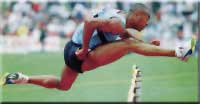 Hurdles
Hurdling is an exciting and challenging event because of its technical and energy demands. The technical component of hurdling is much higher than in sprinting, yet the concept of the hurdles race must be one of a sprint, with adjustments for each hurdle. The stride pattern for sprint hurdling is a 7 to 8 stride pattern to the first hurdle followed by a 3-stride pattern between the hurdles. Appropriate drills can be used to help develop the athlete's hurdling technique.
Sprint Hurdling Technique
The Start and Approach
In sprint hurdling, the first hurdle is only some seven or eight strides away, so the athlete must come upright at the 3rd or 4th stride, much earlier than the sprinter. The block spacings will have to be slightly altered to enable this to happen. The takeoff foot is placed in the front block using an eight-stride approach.
Hurdle Clearance
The athlete must attack the hurdle and aim to clear it by approx. 17 to 18 cm, as quickly and efficiently as possible, raising their centre of gravity slightly more than in a usual sprint.
Leg Action
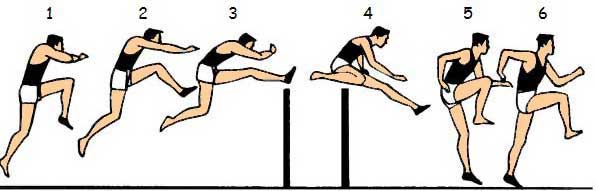
The last stride of the approach to the first hurdle is shortened to allow the takeoff leg to move rapidly under the hips. It ensures that a fast-effective drive can be made across the hurdle. [1] The takeoff distance from the hurdle is 1.98 metres to 2.29 metres (6½ to 7½ feet). The body's centre of gravity is ahead of the foot on takeoff. [1]
The action of the leading leg:
- The knee must be picked up fast [1]
- The knee is driven at the hurdle [1] & [2]
- The lower part of the leg is left low and extends once the knee reaches the height of the barrier [1] & [2]
- The knee must be picked up in line with the vertical centre line of the body.
- There should be no tendency for the knee to be pulled across the body or for the lower leg to go out and round.
- The foot of the lead leg reaches its highest point some 15 to 30 centimetres (6 to 8 inches) in front of the hurdle rail.
- As the heel of the lead leg passes the barrier, it must be pulled down and back to land under the body [3] & [4]
- There is no necessity for the lead leg to be straight over the top of the hurdle [3].
- The leg straightens as it descends towards the ground [4]
- The foot of the lead leg grounds at 114 to 137 centimetres (3¾ to 4½ feet) beyond the hurdle.
The action of the trailing leg:
- The trailing leg drives the body at the hurdle as the lead leg rises [1]
- The recovery of the trail leg must begin from well behind the body if the drive is to be completed
- The athlete should feel the trailing knee sweeping wide and flat over the hurdle [4]
- As the leg crosses the hurdle, the foot must be cocked at the ankle so that the foot does not hit the barrier [4]
- After crossing the barrier, the knee continues to rise and comes around in front of the body [5]
Many young athletes tend to drop the trail leg off to the side after it has crossed the barrier. This has the effect of making the first stride short and pulling the athlete off balance. The trail leg must be pulled through high and fast so that the first stride is fast [5] & [6].
Arm Action
As in sprinting, the arms act to balance the body and counter the rotations produced by the legs. The arm opposite to the lead leg leads the action into the hurdle and pushes/dives forwards as the lead leg rises [1]. The other arm should be taken back in normal sprinting action. As the trail leg comes around the leading arm swings back and wide to counter the rotation of the trail leg [4].
Running Between Hurdles
Three strides are used to cover the ground between the hurdles. To achieve this, the athlete has to modify his sprinting technique to make it fit the gap. A fast leg cadence and a shorter stride length are needed. The athlete may have to use a lower knee lift than in normal sprinting with an emphasis on leg speed.
Key Hurdling Points
The athlete is leaning towards the hurdle and driving the right knee at the hurdle. The leading arm is pushed forward and up (ideally to forehead height). |
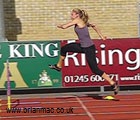 |
The athlete is leaning towards the hurdle and has now lifted the leading (right) foot to clear the hurdle. |
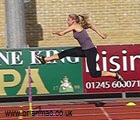 |
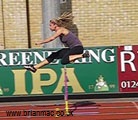
The leading (right) foot is now being pushed down to the track. The knee and foot of the trailing (left) leg are pointing out to the side (towards the camera) to clear the hurdle. |
 |
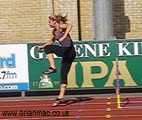
The left knee is driven forward and up once the foot has cleared the hurdle and the toes of the left foot are dorsiflexed. The right leg is straight with the foot's ball contacting the track underneath the hip, the left arm is driven back, and the athlete is still leaning forward. |
 |
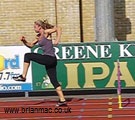
The left knee is quickly pulled high into the stride away from the hurdle. The right leg remains straight, the hips stay high, and the right foot heel does not touch the track, allowing the athlete to sprint away from the hurdle. |
 |
The ratio of the distances from the hurdle for the takeoff point and landing point is approx. 3:1. e.g. the athlete takes off 3 metres from the hurdle and lands 1 metre past the hurdle.
Look at the Sprint Hurdles Photo Sequence of a young Colin Jackson and see if you can see the same key points.
Safety
Hurdling is dangerous on wet grass or any other slippery surface. It is also dangerous for children to run over hurdles in the opposite way to the correct running direction (i.e. with the feet of the hurdles on the far side).
It is vital to help the athletes in the learning situation by using adapted equipment, lowering the hurdles and altering the distance between hurdles.
Hurdles Touchdown Times
The following facility will provide you with checkpoint hurdle touchdown times that can be used when aiming for a particular time goal for 100m Hurdles for women, 110m Hurdles for men and 400m Hurdles for men and women.
The calculations are based on the touchdown times of the top hurdlers at the Olympic games. For a given finishing time, the % of that time for each hurdle has been calculated and then averaged for several top hurdlers.
Enter the target time, select the event, select gender and then click on the "Calculate" button.
Training Programs
A training program has to be developed to meet the athlete's individual needs and consider many factors: gender, age, strengths, weaknesses, objectives, training facilities etc. As all athletes have different needs, a single program suitable for all athletes is not possible.
The following is an annual training program for the 100 metres, 200 metres, 400 metres and Sprint Hurdle events.
Specifications
The specification for the hurdle height depends on the event distance, gender and age.
Sprint Hurdles Men
| Age Group | Distance | Number of Hurdles | Height | Toppling Weight | Track Colour | Distance to Hurdle 1 | Distance Between | Distance to Finish |
| Senior | 110m | 10 | 106.7cm | 3.6kg | Blue | 13.72m | 9.14m | 14.02m |
| U20 | 110m | 10 | 99.1cm | 3.6kg | Blue | 13.72m | 9.14m | 14.02m |
| U17 | 100m | 10 | 91.4cm | 2.7kg | Yellow | 13.00m | 8.50m | 10.50m |
| U15 | 80m | 8 | 84.0cm | 2.7kg | Black | 12.00m | 8.00m | 12.00m |
| U13 | 75m | 8 | 76.2cm | 2.7kg | Orange | 11.50m | 7.50m | 11.00m |
Low Hurdles Men
| Age Group | Distance | Number of Hurdles | Height | Toppling Weight | Track Colour | Distance to Hurdle 1 | Distance Between | Distance to Finish |
| Senior | 400m | 10 | 91.4cm | 3.6kg | Green | 45m | 35m | 40m |
| U20 | 400m | 10 | 91.4cm | 3.6kg | Green | 45m | 35m | 40m |
| U17 | 400m | 10 | 84.0cm | 2.7kg | Green | 45m | 35m | 40m |
Sprint Hurdles Ladies
| Age Group | Distance | Number of Hurdles | Height | Toppling Weight | Track Colour | Distance to Hurdle 1 | Distance Between | Distance to Finish |
| Senior | 100m | 10 | 84.0cm | 3.6kg | Yellow | 13.00m | 8.50m | 10.50m |
| U20 | 100m | 10 | 84.0cm | 3.6kg | Yellow | 13.00m | 8.50m | 10.50m |
| U17 | 80m | 8 | 76.2cm | 2.7kg | Black | 12.00m | 8.00m | 12.00m |
| U15 | 75m | 8 | 76.2cm | 2.7kg | Orange | 11.50m | 7.50m | 11.00m |
| U13 | 70m | 8 | 68.5cm | 2.7kg | Pink | 11.00m | 7.00m | 10.00m |
Low Hurdles Ladies
| Age Group | Distance | Number of Hurdles | Height | Toppling Weight | Track Colour | Distance to Hurdle 1 | Distance Between | Distance to Finish |
| Senior | 400m | 10 | 76.2cm | 3.6kg | Green | 45m | 35m | 40m |
| U20 | 400m | 10 | 76.2cm | 3.6kg | Green | 45m | 35m | 40m |
| U17 | 300m | 7 | 76.2cm | 2.7kg | Green | 50m | 35m | 40m |
Evaluation Tests
The following evaluation tests can be used to monitor the sprint athlete's development:
- 10 stride test for 100m and 200m athletes
- 150 metres Endurance test for 100m athletes
- 250 metres Endurance test for 200m athletes
- 30 metres acceleration test for 100m and 200m athletes
- 400 metres Control tests for 400m athletes
- 400 metres Drop off test for 100m and 200m athletes
- 60 metre speed test for 100m and 200m athletes
- Balke VO2 max test for endurance
- Cooper VO2 max test for endurance
- Flying 30 metres speed test for 100m and 200m athletes
- Harvard step test - a measure of cardiovascular fitness
- Leg Elastic Strength test
- McCloy Physical Fitness test
- Quadrathlon an excellent all-around test
- Queens College Step Test - a measure of cardiovascular fitness
- RAST - Running-based Anaerobic Sprint Test
- Standing Long Jump test
- Strength test - upper body (Bench Press)
- Strength test - lower body (Leg Press)
- Sit-Ups test - abdominal strength
- Sit and Reach test - lower back and hamstring test
- Vertical Jump test
Rules of Competition
The competition rules for this event are available from:
Free Calculator
- Hurdle Touchdown Times - a free Microsoft Excel spreadsheet that you can download and use on your computer.
Page Reference
If you quote information from this page in your work, then the reference for this page is:
- MACKENZIE, B. (2001) Sprint Hurdle [WWW] Available from: https://www.brianmac.co.uk/hurdles/index.htm [Accessed