

Javelin
To achieve maximum distance in the javelin, the athlete must balance three components - speed, technique and strength. The information on this page is for a right-handed thrower.
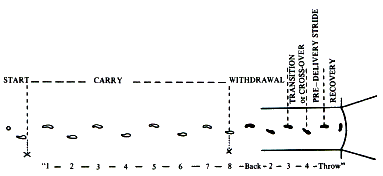
Throwing the javelin comprises the following phases:
|
 |
Basic Technique
Please note that the diagram shows a left-handed thrower.
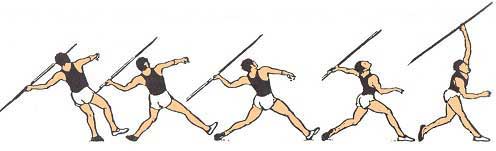
Working from left to right in the above standing throw picture sequence:
- The weight should be over the rear leg
- Hips are forward
- The feet should be in line with the throwing direction
- The throwing arm held parallel to the ground, long and relaxed with the palm uppermost
- The rear leg drives the hips to the front, transferring the weight from the rear to the front leg
- The arm is brought in fast and last
- The elbow should be kept high and close to the head, with the javelin being thrown over the top of the head
The Grip
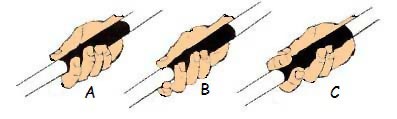
A strong and stable grip is acquired. The grip must remain firm behind the ledge made by the binding (cord), and the javelin must run down the length of the palm and not across it. The fingers, which are not secured above the binding, must press firmly on the javelin to produce a natural spin at release. The 'V' grip (C) is probably the most efficient for the novice thrower as it emphasises the supporting role of the palm. Grip 'B' is the one used by most experienced throwers.
Start and Carry
The aim is to carry the javelin to allow the muscles of the right shoulder, arm and wrist to relax and smooth running action.
- Stand with right foot forward
- Carry the javelin above the shoulders or head
- Right elbow points forward
- The palm of the right-hand points at the sky to provide a platform for the javelin to sit in
- Javelin points in the direction of the run-up - point slightly down
Approach Run
Experienced throwers will use an approach run of 13 to 17 strides - inexperienced throwers will use fewer strides.
- Run on the balls of the feet with hips high
- Free arm to swing more across the body
- Carrying arm to flex to maintain carry position of the javelin
- Speed to match the athlete's physical and technical abilities
Withdrawal
The aim is to ensure the withdrawal movement does not affect the athlete's momentum. A checkmark can be used to indicate the start of the withdrawal phase that commences with the right foot and lasts for two strides.
- At the checkmark, the athlete accelerates ahead of the javelin rather than physically pushing the shoulders and javelin back
- Head remains facing in the direction of the throw
- Maintain hips at right angles to the direction of running
- Drive the right leg forwards and upwards to help maintain the correct position of the hips
Transition
The aim of the transition phase, also known as the cross-over is to place the right foot ahead of the athlete's centre of gravity to produce the characteristic lean back. This must be achieved by advancing the right foot forward and not by leaning back.
- The right foot remains close to the ground to maintain forward momentum
- Right heel contacts with the ground
- As the right foot is advanced, the left foot is advanced ahead of the vertical axis to be in place, ready for a quick plant after the right foot has landed - the trunk is inclined backwards at an angle of about 115° to the forward horizontal direction
- The crossover phase ends when the right foot contacts the ground and the left leg is forward in the air
Pre-delivery stride
- The left leg reaches forward
- Shoulders & hips are now in line with the direction of the throw
- The athlete waits for the ground to come up and meet the left foot
- Trunk is upright
- Head facing the direction of the throw
- Shoulders and javelin parallel
- Throwing hand above the level of the shoulder
Delivery
- Following contact of the left foot with the ground, the left side must brace against a thrusting right leg action
- Right leg drives upwards and forwards, bringing the hips at 90° to the direction of the throw
- The hip thrust is followed with the shoulders and chest turning square to the front and lining up with the hips, and bringing the elbow of the throwing arm forward
- The throwing shoulder is brought over the left leg
- The left leg should lift as the athlete rides over it, and the throwing arm now comes into play
- Arm strikes fast with the elbow high and close to the midline
- The release angle (angle between the horizontal and the javelin) has to consider aerodynamic lift and drag.
Recovery
The left foot remains grounded, and the right leg is brought past it to halt the athlete. The amount of space needed to stop before the scratch line depends on the amount of horizontal momentum. This is typically 1.5 to 2 metres. Adjustment of the checkmark is required to achieve optimum distance on the runway.
Skill Drills
Running activities without the Javelin
- At a steady speed
- With acceleration
- Sideways
- With repeated crossovers
- Crossovers mixed with normal running
- Over low obstacles between each stride
Running activities with the Javelin
- At a steady speed
- With acceleration
- With repeated crossovers
- Crossovers mixed with normal running
- Over low obstacles between each stride
- With repeated withdrawals
Throwing drills can also be performed using a medicine ball, Javelin or sling ball
Optimum Distance
The distance achieved in the javelin is dependent on three parameters:
- the height of release of the javelin
- the angle of release of the javelin
- the speed of release of the javelin
The parameter that has the greatest effect on the potential distance is the speed of release of the javelin.
Optimum Release Angle
Research (Bartonietz 1995)[2] has shown that athletes cannot throw at the same speed for all projection angles. With ballistics, the same initial speed is applied to the projectile regardless of the projection angle. As the angle increases, so the speed decreases. This decrease in speed is a result of two factors:
- As the angle increases, the athlete must expend more energy in overcoming the weight of the javelin, and so less effort is available to develop the release speed of the javelin
- The structure of the body favours a throw in the horizontal direction
Each athlete has a unique release velocity and release angle combination that depends on their size, strength, and throwing technique. Each athlete has their own specific optimum release angle. Bartonietz (2000)[1] identifies that the optimum release angle for a world-class javelin thrower may be 33°± 7°
Specifications
The weight specification for the javelin depends on gender and age.
| Gender\Age | 11-12 | 13-14 | 15-16 | 17-19 | 20-34 |
| Male | 400 grams | 600 grams | 700 grams | 800 grams | 800 grams |
| Female | 400 grams | 500 grams* | 500 grams* | 600 grams | 600 grams |
* British Athletics changes of implements for 2014
| Gender\Age | 35-49 | 50-59 | 60-69 | 70-79 | 80+ |
| Male | 800 grams | 700 grams | 600 grams | 500 grams | 400 grams |
| Female | 600 grams | 500 grams | 400 grams | 400 grams | 400 grams |
Training Programs
A training program has to be developed to meet the athlete's individual needs and consider many factors: gender, age, strengths, weaknesses, objectives, training facilities etc. As all athletes have different needs, a single program suitable for all athletes is not possible.
Training Pathway
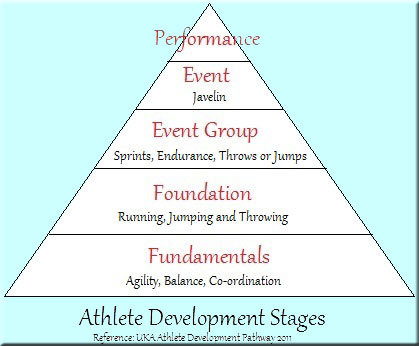
Athletes in the Event Group stage
The following is an annual training program suitable for athletes in the Event Group Development stage:
Athletes in the Event stage
The following is an example of a specific annual training program suitable for athletes in the Event development stage:
Evaluation Tests
The following evaluation tests can be used to monitor the athlete's development:
- 60 metres speed test
- Quadrathlon
- Strength test - upper body (Bench Press)
- Strength test - lower body (Leg Press)
- Sit-Ups test - abdominal strength
- Sit and Reach test - lower back and hamstring test
- Vertical Jump test
Rules of Competition
The competition rules for this event are available from:
References
- BARTONIETZ, K. (2000) Javelin throwing an approach to performance development. In: ZATSIORSKY, V. (2000) Biomechanics in sport, Oxford, Blackwell Science, pp. 401-434
- BARTONIETZ, K. and BARTONIETZ, A. (1995) The throwing events at the World Championships in Athletics 1995, Goteborg - Technique of the world's best athletes, Part 1:shot putt and hammer throw. New Studies in Athletics, 10 (4), pp. 43-63
Page Reference
If you quote information from this page in your work, then the reference for this page is:
- MACKENZIE, B. (2002) Javelin [WWW] Available from: https://www.brianmac.co.uk/javelin/index.htm [Accessed