

The Olympics Games
Citius - Altius - Fortius
Founder of the Olympics
Baron Pierre de Coubertin, born in 1863, is credited with creating the modern Olympics. He was passionate about harnessing education and sport to improve society and believed that reviving the Olympic Games' ancient Greek tradition would bring about such an improvement.
The Baron founded the International Olympic Committee (IOC) in 1884 and began organising the first Games in Athens (1896). He was in the business of "making men"; to "adhere to an ideal of a higher life, to strive for perfection"; to create "a four-yearly festival of the springtime of mankind". Sadly, this vision did not extend to female athletes. Female athletes first participated in the Olympic Games in 1900 in Paris when Charlotte Cooper (Britain) was the first female gold medallist in the tennis singles. Medals were not awarded to winners until the 1908 games in London.
After the first successful Olympics in 1896, de Coubertin became president of the IOC, a post he held until 1925. He died of a stroke in 1937 and following his last wishes, the Baron was buried in Lausanne, but his heart was interred in a monument at the ruins of Olympia.
Olympic Motto
The Olympic motto is:
- citius - altius - fortius
- swifter - higher - stronger
Olympic Oath
The Olympic Oath, instituted in 1920 and updated in 2000, is taken on behalf of all athletes by a member of the host team. While holding a corner of his national flag, the athlete proclaims from the rostrum, the following:
"In the name of all the competitors, I promise that we shall take part in these Olympic Games, respecting and abiding by the rules which govern them, committing ourselves to a sport without doping and without drugs, in the true spirit of sportsmanship, for the glory of sport and the honour of our teams."
Olympic Flag
| The five interlaced rings represent the five continents of the world, and the six colours appear on all the national flags of the world now. The Olympic flag was first flown at the Antwerp Olympic stadium in 1920. | 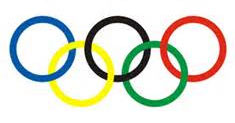 |
Locations
The summer and winter Olympic Games have been held at the following locations:
| Year | Summer Games | Winter Games |
| 1896 | Athens | |
| 1900 | Paris | |
| 1904 | St Louis | |
| 1908 | London | |
| 1912 | Stockholm | |
| 1920 | Antwerp | |
| 1924 | Paris | Chamonix |
| 1928 | Amsterdam | St, Moritz |
| 1932 | Los Angeles | Lake Placid |
| 1936 | Berlin | Garmisch-Partenkirchen |
| WWII | ||
| 1948 | London | St Moritz |
| 1952. | Helsinki | Oslo |
| 1956 | Melbourne | Cortina d'Ampezzo |
| 1960 | Rome | Squaw Valley |
| 1964 | Tokyo | Innsbruck |
| 1968 | Mexico City | Grenoble |
| 1972 | Munich | Sapporo |
| 1976 | Montreal | Innsbruck |
| 1980 | Moscow | Lake Placid |
| 1984 | Los Angeles | Sarajevo |
| 1988 | Seoul | Calgary |
| 1992 | Barcelona | Albertville |
| 1994 | Lillehammer | |
| 1996 | Atlanta | |
| 1998 | Nagano, Japan | |
| 2000 | Sydney | |
| 2002 | Salt Lake City | |
| 2004 | Athens | |
| 2006 | Turin, Italy | |
| 2008 | Beijing, China | |
| 2010 | Vancouver, Canada | |
| 2012 | London | |
| 2014 | Sochi, Russia | |
| 2016 | Rio de Janeiro, Brazil | |
| 2018 | Pyeongchang, South Korea | |
| 2020 | Tokyo | |
| 2022 | Beijing | |
| 2024 | Paris | |
| 2026 | ||
| 2028 | Los Angeles | |
Summer Sports
The summer sports have included Aquatics, Archery, Athletics, Badminton, Baseball, Basketball, Boxing, Canoeing, Cycling, Equestrian, Fencing, Football, Gymnastics, Handball, Hockey, Judo, Pentathlon, Rowing, Sailing, Shooting, Softball, Table tennis, Taekwondo, Tennis, Triathlon, Volleyball, Weight Lifting and Wrestling.
Only five sports have been contested at every Summer Olympic Games since 1896, and they are:
- Athletics, Cycling, Fencing, Gymnastics and Swimming
Only three countries have competed at every summer Olympics, and they are:
- Australia, Greece and Great Britain
Impact of politics on the games
- 1948 London - The first Olympics since the war, and Europe was still recovering from the devastation. Food shortages meant that each country was asked to bring food for its athletes. Japan and Germany were not invited.
- 1952 Helsinki - USSR re-joined the Games, having absented itself since 1912 due to the Games' capitalist and bourgeois nature. A cold-war atmosphere dominated the games as the Soviets set up a rival Olympic village for Eastern Bloc countries.
- 1964 Tokyo - South Africa was banned by the IOC due to its oppressive apartheid regime. This ban lasted until 1992.
- 1968 Mexico City - 10 days before the Olympics began, students protesting against the government were surrounded by the army who opened fire, killing 267 and injuring more than 1,000. During the Games, American athletes Tommie Smith and John Carlos were expelled for raising their fists in a "black power" salute on the winners' podium.
- 1972 Munich - 11 Israeli athletes were taken hostage by Palestinian terrorists "Black September", to protest against 234 Palestinian prisoners in Israel. The terrorists murdered two of their captives; then, a bungled rescue attempt by the authorities, the remaining nine captives were killed alongside three of their captors.
- 1976 Montreal - 26 African countries boycotted the Games in response to New Zealand's inclusion. Earlier that year, the Kiwis had undertaken a three-month rugby tour of segregated South Africa, but the IOC refused to ban them.
- 1980 Moscow - The biggest boycott in Olympic history blighted the Games when 62 countries, including the USA, West Germany and Japan, refused to attend in protest at the USSR's invasion of Afghanistan. The USSR won 195 medals, but allegations of cheating tainted this astonishing result.
- 1984 Los Angeles - 14 countries, including the USSR, boycotted the Games in what was widely seen as revenge for the Moscow Games four years earlier. Ironically, China chose to return to the Games this year after a 32-year absence.
- 1988 Seoul - After failing to be recognised as co-host of the Games, North Korea (which was still technically at war with the South) boycotted the event, taking Cuba and Ethiopia with it.
- 1992 Barcelona - A rare Olympic games with no boycotts. The Soviet Union had broken up, and the new Russian republics competed under one banner. The Berlin Wall had been torn down - so East and West Germany competed together as a united country. South Africa returned to the Games after the end of apartheid and 32 years of sporting isolation.
- 1996 Atlanta - First games to be held without any governmental support resulting in the commercialisation of future Olympics. 197 countries, including Hong Kong and the Palestinian Authority, participated in the games.
- 2000 Sydney - 10,651 athletes competing in 300 events. The Aboriginal athlete Cathy Freeman lit the Olympic torch.
- 2004 Athens - Greece is the birthplace of the ancient Olympic Games more than 2,000 years ago, and Athens staged the first modern Olympic Games in 1896.
- 2008 Beijing - The games provoked outrage from human rights groups who felt that allowing China to host the Games legitimised their repressive regime.
- 2012 - London - This was the biggest security operation Britain had faced for decades, as the number of security personnel totalled 40,000. On 7 July 2005, the day after the city was selected to host the Olympics, the London Underground and a London bus were attacked by the terrorist group Al-Qaeda. The final cost of the security operation was estimated at £553m
- 2016 Rio - Zika virus is suspected of causing birth defects and has been declared a global public health emergency by the World Health Organization. 312 positive Russian tests across 28 Olympic sports were covered up by officials, the ban of the country's entire track and field team was upheld. Severe water pollution was documented in the venues for sailing, rowing and other water sports.
Social Impact
The positive social impact of large events, like the Olympic games, on the hosting country, can include:
- an increase in the interest and participation in sporting activities
- reinforce national/local pride and community spirit
- improve the quality of life
- attract more investment and visitors
- improve public roads & transport
- increase local house building
- generate new businesses and jobs
- improve the skill base
Page Reference
If you quote information from this page in your work, then the reference for this page is:
- MACKENZIE, B. (2004) The Olympics Games [WWW] Available from: https://www.brianmac.co.uk/olympics.htm [Accessed