

High Jump - Fosbury Flop
The high jump comprises four phases: approach, take off, flight and landing.
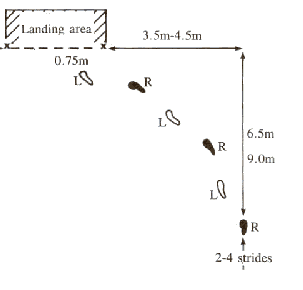 The Approach
Factors to look for in the approach:
- 2 or 4 strides lead into a checkpoint
- non-take off foot hits this checkpoint
- followed by a curved five-stride approach to the take-off point
- in the last 3 to 4 strides, the athlete is inclined away from the bar
- final strides to be fast and hips kept high
Take off
Factors to look for on take-off:
- the take-off point is approx. 0.5 metres to 0.75 metres from the near upright along the bar and out from the bar
- the take-off foot is slightly ahead of the athlete's body
- the take-off foot plant is an active flat down and back action
- the take-off foot is pointing towards a position halfway between the middle of the bar and the far upright (10° to 20°)
- the take-off foot is in alignment with the take-off leg
- the hips are forward
- the inside shoulder is high
- the trunk is upright and leaning slightly back - not leaning towards the bar
- the hips are at 45° to the bar and the shoulders at 90°
- there is a quick and vigorous movement of the free limbs
- the inside shoulder does not drop in towards the bar
- rotation comes from the non-jumping side, i.e. the free leg and shoulder pulling across the body
- the leg nearest the bar is driven up bent and high at the opposite upright, thigh and foot parallel with the ground and lower leg vertical
- both arms are swung forwards and upwards with the free leg
Flight
Once off the ground, factors to look for in the flight:
- inside knee stays up at bar level
- heels are pulled back towards the head (arching the back)
- knees bent and wide apart
- arms in a crucifix position or held by the side
- head back and look towards the far back corner of the mat (forces the hips to stay high)
- once the hips are over the bar, the legs are snapped straight from the knees
- landing on the shoulders
High Jump Drills
In all drills, stress "Trunk upright, hips forward and head high".
- 2 × 20m walking - lifting the heel and stretching the ankle quickly
- 2 × 20m bouncing ankle extension
- 2 × 20m bounding arm drill
- 5 × 3 or 5 stride vertical jump drill (ankle extension, free knee drive, arm action)
- Three stride practice jumps, concentrating on specific body parts (5 to 10 jumps).
Training Programs
A training program has to be developed to meet the athlete's individual needs and consider many factors: gender, age, strengths, weaknesses, objectives, training facilities etc. As all athletes have different needs, a single program suitable for all athletes is not possible.
Training Pathway
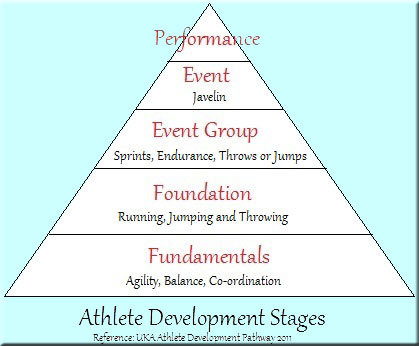
Athletes in the Event Group stage
The following is an annual training program suitable for athletes in the Event Group Development stage:
Athletes in the Event stage
The following is an example of a specific annual training program suitable for athletes in the Event development stage:
Evaluation Tests
The following evaluation tests can be used to monitor the high jump athlete's development:
- Leg Elastic Strength test
- Standing Long Jump test
- Strength test - upper body (Bench Press)
- Strength test - lower body (Leg Press)
- Sit-Ups test - abdominal strength
- Sit and Reach test - lower back and hamstring test
- Vertical Jump test
Rules of Competition
The competition rules for this event are available from:
Page Reference
If you quote information from this page in your work, then the reference for this page is:
- MACKENZIE, B. (2001) High Jump - Fosbury Flop [WWW] Available from: https://www.brianmac.co.uk/highjump/index.htm [Accessed