

Planning the Training
A Training Plan aims to identify the work to be carried out to achieve agreed objectives. Training Plans should be drawn up to identify long-term (4 years) goals and short-term plans for the forthcoming season. The plan could comprise a single A4 sheet identifying the overall plan for the year and more detailed weekly plans identifying the specific activities the athlete is to carry out in its simplest form. I will concentrate on developing the short-term annual Training Plan for the rest of this topic.
Training year
The training year's start will depend upon the athlete's circumstances and objectives, but this would generally be around October for track and field athletics.
Information Gathering
The first stage of preparing a Training Plan is to gather background information about your athlete and the forthcoming season's objectives. The sort of information to collect is as follows:
- Personal details
- Name, address, date of birth, telephone numbers, transport arrangements
- Objectives
- Performance (time, height, distance)
- Technical (development of event technique)
- Indoor and/or outdoor season
- Experience
- Personal best (PB's)
- Competition experience (club, county, national, country)
- Equipment
- Does the athlete have his equipment (e.g. starting blocks, javelin, etc.)?
- Harness and tyre
- Elastic harness
- Weight jackets
- Video camera
- Distance, time, % effort matrix chart
- Finance
- Where can grants be obtained from?
- Competition
- Date of the main competition
- National and Area Championships
- School, University competitions
- Required qualification times for competitions
- Fixture lists - Club, County etc.
- Open Meetings
- Competitors
- Who is the competition and what are their PB's?
- Recent competition results
- Competition behaviour
- Athlete's other Commitments
- School, college, work, part-time jobs
- Family and partner
- Hobbies and other sports
- Time available for training
- Planned holidays
- Medical
- Previous injuries or illness
- Current problems (diabetes, asthma etc.)
- Access to medical support
- Physiotherapy support
- On any medication - is it a banned substance?
- Using asthma inhaler - application to use Beta 2 agent inhalers
- Training facilities
- Tracks and other running facilities (bad weather)
- Gymnasiums and weight training
- Swimming pools, saunas and massage
- Coaching Workshops
- Last season
- What can be learnt from last season - good and bad aspects
- Key questions for the athlete
- How serious are you about your athletics?
- What do you expect from your coach?
Analysis of the last program
If this is not the first program you have generated with the athlete, then a vital activity to conduct is a SWOT analysis of the last training program:
- Strengths
- What were the best aspects of the program and why?
- What did we do well, and why?
- Weaknesses
- Are there gaps in the program?
- What did we not do very well, and why?
- Opportunities
- How can we enhance the program for the benefit of the athlete?
- Threats
- What may prevent us from achieving the short- and long-term objectives?
Athlete Assessment
Before creating a training program, we must analyse our athletes to determine their strengths and weaknesses. The first step is to identify the ideal attributes (e.g. body build, strength, endurance, speed, flexibility, etc.) to allow our athlete to achieve their goals. The next step is to assess our athletes against our ideal athletes to identify their strengths and weaknesses (gap analysis). Addressing the gaps may require us to think about long-term planning (4-8 years), but we can set realistic but challenging goals to start addressing the gaps for this macrocycle. The following link provides an example form for this athlete analysis process.
Periodisation
Periodisation is the method of organising the training year into phases where each phase has its specific aims for the athlete's development
The phases of a training year
The training year is divided into 6 phases, as follows:
- Phase 1 - 16 weeks - Oct, Nov, Dec, Jan
- Phase 2 - 8 weeks - Feb, Mar
- Phase 3 - 8 weeks - Apr, May
- Phase 4 - 8 weeks - Jun, Jul
- Phase 5 - 8 weeks - Jul, Aug
- Phase 6 - 4 weeks - Sep
It assumes that the competition climax will be in August
What if there is an indoor and an outdoor season?
For the athlete with competitive objectives for both the indoor and outdoor season, then the phase allocation for the indoor season could be as follows:
- Phase 1 - 6 weeks - Oct, Nov
- Phase 2 - 8 weeks - Nov, Dec, Jan
- Phase 3 - 6 weeks - Jan, Feb
and the outdoor season is as follows:
- Phase 1 - 4 weeks - Feb, Mar
- Phase 2 - 6 weeks - Mar, Apr
- Phase 3 - 5 weeks - Apr, May
- Phase 4 - 7 weeks - Jun, Jul
- Phase 5 - 6 weeks - Jul, Aug
- Phase 6 - 4 weeks - Sep
It assumes that the indoor season's climax is in February and the outdoor season is in August. Depending on your athlete's objectives and abilities, the year starts, and the duration of each phase may have to be adjusted to achieve appropriate development.
Objectives of each phase
The objectives of each phase are as follows:
- Phase 1 - General development of strength, mobility, endurance and basic technique
- Phase 2 - Development of specific fitness and advanced technical skills
- Phase 3 - Competition experience - the achievement of indoor objectives
- Phase 4 - Adjustment of the technical model, preparation for the main competition
- Phase 5 - Competition experience and achievement of outdoor objectives
- Phase 6 - Active recovery - planning preparation for next season
Activities of each Phase
The athlete's physical needs that require development are:
- Basic body Conditioning
- General and Specific Strength
- General and Specific Technique
- General and Specific Mobility
- General and Specific Endurance
- Speed
Each of these needs should be seen as a building block, where specific blocks must be in place before you progress to the next. Failure to do this may result in injury. How you allocate the blocks to each phase depends upon the athlete's weaknesses and strengths and is for you, as the coach, to decide with the athlete.
One approach is to progress the building blocks as follows:
- basic body conditioning
- general strength, endurance, mobility and technique
- specific strength, endurance, mobility and technique
- speed
When progressing from one block to the next, remember to fade one out as the other comes in and not switch from one block to the next overnight. Some blocks, once started, may continue to the end of the season but at a less intense level, e.g. mobility. Other blocks to consider are relaxation, visualisation and psychology (mental attitude).
Volume, Intensity & Recovery
The relationship between Volume of work, Intensity of the work and Recovery within the session:
| General Preparation Phase |
Specific Preparation Phase |
Pre-competition Phase |
Competition Phase |
|
| Intensity | Low | Low | Medium | High |
| Volume | High | High | Medium | Low |
| Recovery | Low | Low | Medium | High |
Preparing a plan
The steps in producing a Training Plan are as follows:
- Gathering information
- Produce an overall plan template and identify the months/weeks of the year
- Identify on the plan, at the appropriate period
- the main competition
- area, national, school etc. championships
- qualification competitions
- club fixture meetings
- the 6 phases based on the main competition in phase 5
- Identify on the plan
- the blocks (e.g. strength, endurance) to be developed in each phase
- the period of development for each block
- the intensity of training week by week
- number of training sessions per week
- evaluation points to monitor progress
- Identify appropriate training units for each block as appropriate to the development phase.
- Group the training units for each block into training schedules, considering the number of training sessions the athlete can complete per week, the required training intensity and the development phase.
Athlete Development
As athletes mature, they develop in terms of their sports and education, career, physical maturity, and relationships with those around them. On average, an athlete is likely to face up to seven transitions, and perhaps the critical change occurs around the age of 20, when they may be:
- moving to university/college or commencing in full-time employment
- progressing to a high-performance level
- maturing through adolescence
- establishing relationships with a partner
Coaches must consider these transitions when planning their athletes' annual and long-term training programs.
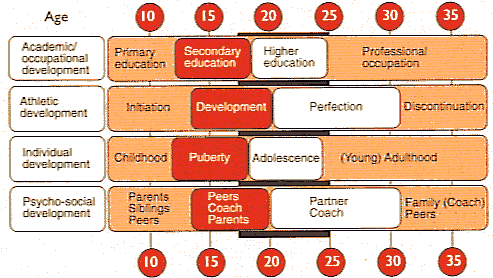
Athlete development model - Wylleman (2004)[1]
What is a Macrocycle, Mesocycle, Microcycle?
A Macrocycle is a period (e.g. 11 months) defining the available preparation time up to a major competition.
This can be divided into developmental periods called Mesocycles. A mesocycle is usually 4-8 weeks in duration and has a specific objective, e.g. general preparation, specific preparation, competition.
A Microcycle is a shorter training period of about 7-10 days and includes more detailed information on the intensity, frequency, duration and sequencing of the Training Sessions.
The following link provides an example of an Annual Training Plan (Macrocycle, Mesocycle and Microcycle) to help guide you in planning an athlete's training program.
What are a training unit and a training session?
A training unit is a single activity (e.g. 6 × 60 metres at 90% effort with 2 minutes recovery) with a set objective (e.g. develop specific endurance). A training session consists of one or more training units, e.g. warm-up unit, Technique drills unit, Speed Endurance unit and a cool-down unit.
What is the training schedule?
A training schedule (microcycle) comprises several training sessions that can span from 7 to 10 days.
Goal Setting
Goal setting is a simple yet often misused motivational technique that can provide some structure for your training and competition program. Goals give a focus, and there are two acronyms to guide goal setting.
SMART or SMARTER
- S - goals must be Specific
- M - training targets should be Measurable
- A - goals should be Adjustable
- R - goals must be Realistic
- T - training targets should be Time based
- E - goals should be challenging and Exciting
- R - goals should be Recorded
SCCAMP
- S - goals must be Specific
- C - within the Control of the athlete
- C - goals are Challenging
- A - goals must be Attainable
- M - training targets should be Measurable
- P - goals are Personal
FITT Principles
The basic principles of fitness training can be summed up in the acronym FITT
- F - Frequency - how often
- I - Intensity - how hard
- T - Time - how long
- T - Type - the type of training (strength, endurance etc.)
RAMP
The basic principles of a warm-up can be summed up in the acronym RAMP
- R - Raise the body's temperature and heart rate
- A - Activate key muscle groups
- M - Mobilise joints
- P - Potentiate/prepare the body for the maximal intensities it will be required to produce in the session/competition
STEP
A simple system for making changes to a sports activity can be summed up in the acronym STEP. Adjust each, or any, of the following to provide different challenges for players and to meet the needs of the individual:
- S - Space - Where the activity is taking place
- T - Task - What is happening
- E - Equipment - What is being used
- P - People - Who is involved
SPORRI
The basic principles of fitness training can be summed up in the acronym SPORRI
- S - Specificity
- P - Progressive
- O - Overload
- R - Rest
- R - Recovery
- I - Individual Differences
SORAR
The basic principles of fitness training can be summed up in the acronym SORAR
- S - Specificity
- O - Overload
- R - Rest
- A - Adaption
- R - Reversibility
Training ages
When developing a training program, it is important, especially for young athletes, to take into consideration the athletes:
- Chronological age - age from date of birth
- Development age - physical, mental and emotional development
- Training age - the number of years they have been seriously training
Long Term Athlete Development (LTAD) is a sports development framework that matches training needs to an athlete's growth and development.
General Annual Training Programs
The following are examples of basic training programs suitable for the young athlete or for the mature athlete who is just starting in Track and Field athletics:
- Sprint events - 100 metres, 200 metres, 400 metres, 4 × 100 metres relay and 4 × 400 metres relay.
- Throw events - Discus, Shot, Javelin and Hammer
- Jump events - High Jump, Long Jump, Triple Jump and Pole Vault
- Endurance events - 800 metres, 1500 metres, 5km, 10km, Race Walking and Steeplechase.
For the experienced athlete, select this link for examples of event-specific annual training programs.
References
- WYLLEMAN, P. et al. (2004) Career Transitions in Sport. Psychology of Sport and Exercise, 5 (1), p. 7-20
Page Reference
If you quote information from this page in your work, then the reference for this page is:
- MACKENZIE, B. (1997) Planning the Training [WWW] Available from: https://www.brianmac.co.uk/plan.htm [Accessed