

Anatomy & Physiology - Body Systems
The Skeletal System
The branches of science that will help you understand the body parts and functions are anatomy and physiology. Anatomy deals with the study of the human body (the components, structure and position) and physiology is the study of how the body functions.
Body Systems
The body comprises several systems: The Cardiovascular system, Digestive system, Endocrine system, Muscular system, Neurological system, Respiratory system and Skeletal system.
The Skeletal System
The skeletal system comprises 206 bones and provides four essential functions:
- Support for tissues and muscle.
- Protection for vital organs.
- Movement through bones and attached muscles.
- Storage for minerals and immature blood cells.
GrowthOssification is the process by which bone is formed. Some bones (e.g. the flat bones of the skull) are formed in one stage from the connective tissue. This process is known as intramembranous or direct ossification. Other bones (e.g. short bones) are formed from the cartilaginous model of the future bone developed in the embryo, dissolved and replaced by bone cells. This process is known as endochondral or indirect ossification - most bones are formed this way. SupportBones and cartilage that make up the skeleton are the only rigid materials in the body. The skeleton's 206 bones provide a framework and points of attachment for many of the body's soft tissues. The five primary classifications of bones are: Long (e.g. femur), Short (e.g. tarsal bones of the foot), Flat (e.g. frontal bone of the skull), Irregular (e.g. vertebrae) and Sesamoid (e.g. kneecap) |
Cross Section of a Long Bone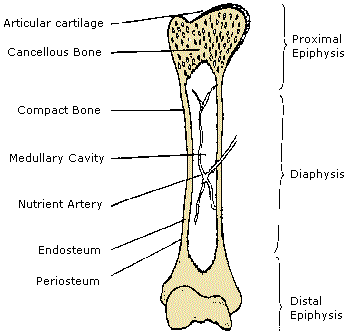 |
Protection
These structures protect some of the body's vital tissues and functional organs. Typical examples are:
- Skull - protects the brain.
- Vertebrae - protects the spinal cord.
- Thoracic cage - protects the heart and lungs.
Movement
Bones act as levers during movement and provide stable structures to which muscles are attached. The joints allow movement between bones, which are directly related to the type of joint and range of motion. Joints fall into one of three categories: Fixed fibrous or Synarthroses (e.g. bones of the skull), Slightly moveable or Amphiarthroses (e.g. symphysis pubis) and Freely movable or diarthrosis.
Freely Movable joints comprise four main groups: Ball and Socket (e.g. hip), Hinge (e.g. elbow), Pivot (e.g. radius and ulna) and Gliding (e.g. carpal joint of the wrist)
Parts of a synovial joint
A fibrous capsule surrounds the joint and is strengthened by ligaments. These joints' stability is dictated by the shape of articulating surfaces, their surrounding ligaments and muscles. For example, two cruciate and collateral ligaments give high knee strength. One of the most complex joints to dislocate is the hip. It is formed with the head of the femur fitting neatly into the socket or acetabulum in the pelvis.
Articular or hyaline cartilage covers and protects the ends of bones that meet to form a joint and allow freedom of movement. It is a hard, smooth material which does not repair itself when damaged.
Tendons connect muscle tissue to bone and, although more elastic than ligaments, have a far higher tensile strength than muscle.
The Synovial membrane lines the joint cavity and covers the tendons and ligaments which pass through it. The membrane produces synovial fluid, which lubricates the joints.
Shoulder Joint
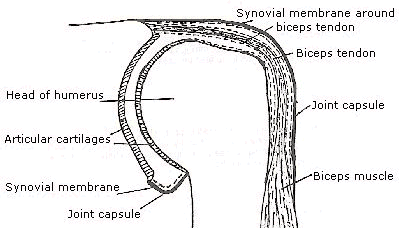
Ligaments are tough fibrous tissue bands that connect bone to bone and help stabilise joints. The strongest ligament in the body is situated at the front of the hip capsule, preventing excessive backward movement of the legs. Although stronger than muscle tissue, ligaments have fewer nerve endings and less blood supply and therefore take longer to repair when damaged. While these strong fibrous bands offer great stability to a joint in preventing excessive movement, they do not necessarily return to their former length if they are stretched or torn through injury. They may remain stretched, therefore offering reduced stability to that particular joint.
A bursa is a small sac formed in connective tissue lined by a synovial membrane containing a small amount of synovial fluid. It is situated between moving parts, often between the tendon and bone, to prevent rubbing.
Storage
Red marrow in some bones produces red blood cells, some white cells and platelets. Minerals, especially calcium and phosphorous, are also stored in bones and distributed to other body parts.
Effect of exercise on the skeletal system
The bone condition may be improved by exercise as it responds to mechanical stresses. These mechanical stresses usually form of skeletal muscle pulling at their points of attachment, being their origins and insertions. Where these mechanical stresses are applied, it has been shown that more mineral salts are deposited, and more collagenous fibres are produced. Therefore, the density and size of bone in these areas may be increased, and these changes in bone structure are stimulated by increased loads being placed on the skeleton. It has been borne out by higher bone mass observed in weightlifters than in lighter endurance athletes, such as joggers. Other examples include racquet players, who have been shown to have a greater bone density in their playing arms. Even if a leg is immobilised by being placed in plaster due to a fracture, the bone becomes decalcified from lack of mechanical stress even after a few weeks.
While exercise may be beneficial to maintaining healthy bones, care for children whose bones and muscles are still developing. They should not be subjected to forms of sport involving high degrees of mechanical stress, partly because of the weaknesses that still exist within the bones and the adverse effects on bones' development before maturity.
There are two main effects on bones as we grow older. Bones begin to lose calcium, which is one factor contributing to osteoporosis. Secondly, less protein is produced with age, altering bone makeup and sometimes creating brittle bones.
Page Reference
If you quote information from this page in your work, then the reference for this page is:
- MACKENZIE, B. (2001) Physiology - Skeletal System [WWW] Available from: https://www.brianmac.co.uk/physiol.htm [Accessed