

Long Term Athlete Development (LTAD)
Sports scientists have reported that there are critical periods in a young person's life in which the effects of training can be maximised. They have also concluded that it can take anything from eight to twelve years of training for a talented athlete to achieve elite status. This has led to the development of athletic models, which identify appropriate training aims at each athlete's physical development stage.
Athletic model indicatorsResearch has shown that chronological age is not a good indicator on which to base athletic development models for athletes between the ages of 10 and 16. Within this age group, there is a wide variation in physical, cognitive and emotional development. One practical solution is to use the onset of Peak Height Velocity (PHV), influenced by genetics and environmental factors (climate, cultural & social), as a reference point for the design of training programs. |
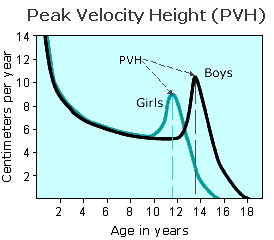 |
PVH is the point in a child's development when they reach their maximum growth rate. Peak weight velocity usually follows shortly after PVH. The average age for PVH is 12 for girls and 14 for boys.
Following PVH, Vo2max and strength increase significantly as a result of growth. Most girls experience their first menstrual cycle approximately one year after PVH.
Using simple measurements (standing height & sitting height) PHV can be monitored, and appropriate training can be set to match the athlete's development.
Model for LTAD
Sports can be classified as early specialization (e.g. gymnastics) or late specialization (e.g. Track and Field, Team sports). Early specialization sports require a four-phase model while a late specialization model requires six phases.
Early Specialization Model |
Late Specialization Model |
|
|
|
Late Specialization Model
Phase 1 - FUNdamentals
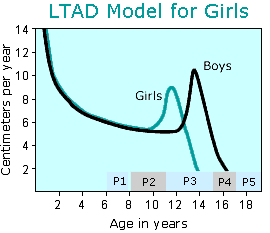
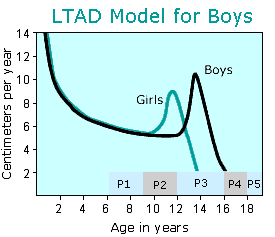
This phase is appropriate for boys aged 6 to 9 and girls aged 5 to 8. The main objective should be to develop the athlete's physical capacities and fundamental movement skills. The key points of this phase are:
- Participation in as many sports as possible.
- Speed, power and endurance are developed using FUN games.
- Appropriate and correct running, jumping and throwing techniques are taught using the ABCs of athletics.
- Introduction to the simple rules and ethics of sports.
- Strength training with exercises which use the child's body weight; medicine ball and Swiss ball exercises.
- Training programs, based on the school year, are structured and monitored but not periodised.
- Develop the athletes:
- ABCs (Agility, Balance, Coordination and Speed).
- RJT (Running, Jumping, Throwing).
- KGBS (Kinesthetics, Gliding, Buoyancy, Striking with a body part).
- CKs (Catching, Kicking, Striking with an implement).
The first critical speed development period will occur during this phase, age 6-8 for girls and 7-9 for boys, respectively. Linear, lateral and multi-directional speed should be developed, and the duration of the repetitions should be less than 5 seconds. Fun and games should be used for speed training, and the volume of training should be lower.
Phase 2 - Learning to train
This phase is appropriate for boys aged 9 to 12 and girls aged 8 to 11. The main objective should be to learn all fundamental sports skills. The key points of this phase are:
- Develop fundamental movement skills.
- Learn general overall sports skills.
- Continue to develop strength with a medicine ball, Swiss ball and own body-weight exercises as well as hopping-bounding exercises.
- Continue to develop endurance with games and relays.
- Introduce basic flexibility exercises.
- Continue to develop speed with specific activities during the warm-up, such as agility, quickness and change of direction.
- Develop knowledge of warm-up, cool-down, stretching, hydration, nutrition, recovery, relaxation and focusing.
- Training programs are structured and based on a single periodisation.
- Competition is structured, and a 70:30 training/practice-to-competition ratio is recommended.
Phase 3 - Training to train
This phase is appropriate for boys aged 12 to 16 and girls aged 11 to 15. The main objective should be to develop the athlete's physical capacities (focus on aerobic conditioning) and fundamental movement skills. The key points of this phase are:
- Develop speed and sport-specific skills.
- Develop the aerobic base - after the onset of PHV.
- Learn correct weight-lifting techniques.
- Develop knowledge of how and when to stretch, optimise nutrition and hydration, mental preparation, taper and peak.
- Establish pre-competition, competition and post-competition routines.
- The strength training window for boys begins 12 to 18 months after PHV.
- There are two windows of opportunity to strength training for
girls
- Window one is immediately after PHV.
- Window two begins with the onset of menarche (the first menstrual period).
- Special emphasis is also required for flexibility training due to the sudden growth of bones, tendons, ligaments and muscles.
- A 60% training to 40% competition ratio (including competition and competition-specific training) is recommended.
Phase 4 - Training to compete
This phase is appropriate for boys aged 16 to 18 and girls aged 15 to 17. The main objective should be to optimise fitness preparation, sport/event-specific skills and performance. The key points of this phase are:
- 50% of the available time is devoted to the development of technical and tactical skills and fitness improvements.
- 50% of the available time is devoted to competition and competition-specific training.
- Learn to perform these sport-specific skills under a variety of competitive conditions during training.
- Special emphasis is placed on optimum preparation by modelling training and competition.
- Fitness programs, recovery programs, psychological preparation and technical development are now individually tailored to the athlete's needs.
- Double and multiple periodisations are the optimal framework of preparation.
Phase 5 - Training to win
This phase is appropriate for boys aged 18+ and girls aged 17+. The main objective should be to maximize fitness preparation and sport/event-specific skills and performance. The key points of this phase are:
- All of the athlete's physical, technical, tactical, mental, personal and lifestyle capacities are now fully established, and the focus of training has shifted to the maximization of performance.
- Athletes train to peak for major competitions.
- Training is characterized by high intensity and relatively high volume with appropriate breaks to prevent overtraining.
- The training-to-competition ratio in this phase is 25:75, with the competition percentage including competition-specific training activities.
Phase 6 - Retirement & retainment
The main objective should be to retain athletes for coaching, officiating, sports administration etc.
LTAD Model
The diagrams below show the above Late Specialization LTAD Model phases for boys and girls.
|
|
British Athletics Model
The following is an example of a five-stage progression (British Athletics model) for long-term athlete development:
- Fundamentals - where the emphasis is on fun, developing basic fitness and general movement skills - training years 1 to 3 and ideally a chronological age of 6 to 13.
- Foundation - Learning to Train - where the emphasis is to learn how to train and develop their general skills - training years 3 to 5 and ideally a chronological age of 10 to 15.
- Event Group - Training to Train - where the emphasis is event(s) specific training - training years 5 to 7 and ideally a chronological age of 13 to 17.
- Event - Training to Compete - the emphasis is to correct weaknesses and develop athletic abilities - training years 7 to 9 and ideally a chronological age of 15 to 19.
- Performance - Training to Win - where the emphasis is on enhancing performance - training years 10+ and ideally a chronological age of 18+.
Page Reference
If you quote information from this page in your work, then the reference for this page is:
- MACKENZIE, B. (2006) Long Term Athlete Development (LTAD) [WWW] Available from: https://www.brianmac.co.uk/ltad.htm [Accessed