

Agility
Agility is the ability to change the direction of the body efficiently and effectively, and to achieve this, and you require a combination of:
- Balance
- The ability to maintain equilibrium when stationary or moving (i.e. not to fall over) through the coordinated actions of our sensory functions (eyes, ears and the proprioceptive organs in our joints)
- Static Balance - ability to retain the centre of mass above the base of support in a stationary position
- Dynamic Balance - the ability to maintain balance with body movement
- Speed
- the ability to move all or part of the body quickly
- Strength
- the ability of a muscle or muscle group to overcome a resistance
- Coordination
- the ability to control the movement of the body in cooperation with the body's sensory functions, e.g. catching a ball (ball, hand and eye coordination)
How do we improve agility?
We can improve our agility by enhancing the parts of agility (listed above) and practicing them in training.
Agility Ladder
The main objective of agility ladder programs is to promote a wide range of different foot and movement patterns. These movements will become second nature through practice, and the body will be able to respond quickly to various sport-specific movement patterns.
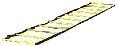 Using an agility ladder, we can improve our agility by practising movement patterns in training. The
standard ladder is 10 yards long with 18-inch squares, but you can construct
your ladder using sticks, lino strips or tape.
Using an agility ladder, we can improve our agility by practising movement patterns in training. The
standard ladder is 10 yards long with 18-inch squares, but you can construct
your ladder using sticks, lino strips or tape.
When beginning an agility ladder program, start with 2 to 4 drills and once you master these, introduce new drills.
Ladder Assessment
Speed through a ladder can indicate much about an athlete's quickness. Less than 2.8 seconds for males and 3.4 seconds for females for running the length of a 20-rung ladder, one foot in each rung at a time, is considered excellent for senior athletes.
Exercises
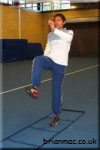
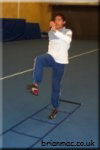
Detailed below are some ladder drills you could use.
Exercise 1 |
Exercise 2 |
|
|
Exercise 3
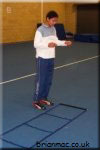 Fig 3a |
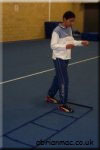 Fig 3b |
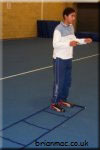 Fig 3c |
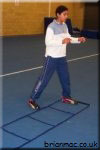 Fig 3d |
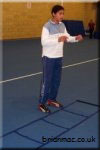 Fig 3e |
- Begin by standing sideways on the ladder (Fig 3a)
- Moving laterally to your right, step into the first square with the right foot (Fig 3b)
- Step in with the left foot (Fig 3c)
- Step back out with the right foot (Fig 3d)
- Step back out with the left foot (Fig 3e)
- Repeat the sequence from 2 to 5 along the ladder
Exercise 4
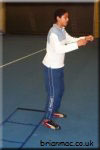 Fig 4a |
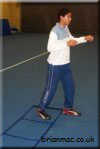 Fig 4b |
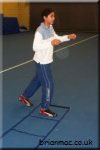 Fig 4c |
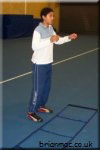 Fig 4d |
- Perform the drill in a sideways position to the ladder (Fig 4a)
- Moving to the right, place the right foot into the first square (Fig 4b)
- Next, step across the ladder with the left foot (Fig 4c)
- Remove the right foot from the ladder, placing it next to your left foot (Fig 4d)
- Now, step forward into the second square with the left foot
- Next, step across the ladder with the right foot
- Remove the left foot from the ladder, placing it next to your right foot
- Repeat the sequence from 2 to 7 along the ladder
Exercise 5
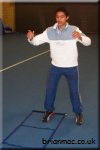 Fig 5a |
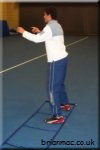 Fig 5b |
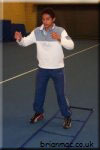 Fig 5c |
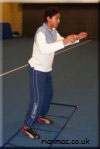 Fig 5d |
 Fig 5e |
- Start straddling one side of the ladder - right foot in the first square and your left foot outside of the ladder (Fig 5a)
- Do a jump to your right, so your right foot stays in the ladder square and your left foot lands in the next ladder square (Fig 5b)
- Do a jump to your left, so your left foot stays in the ladder square and your right foot lands outside the ladder (Fig 5c)
- Do a jump to your left, so your left foot stays in the ladder square and your right foot lands in the next ladder square (Fig 5d)
- Do a jump to your right, so your right foot stays in the ladder square and your left foot lands outside the ladder (Fig 5e)
- Repeat the sequence from 2 to 5 along the ladder
Exercise 6
Fig 6a |
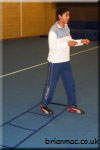 Fig 6b |
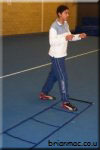 Fig 6c |
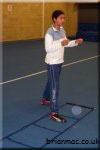 Fig 6d |
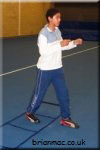 Fig 6e |
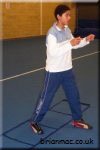 Fig 6f |
- Begin standing sideways to the ladder (Fig 6a)
- Step into the first square with the right foot (Fig 6b)
- Next, step over the ladder to the other side with the left foot (Fig 6c)
- Step with the right foot laterally to the next square (Fig 6d)
- Next, step over the ladder to the other side with the left foot (Fig 6e)
- Step with the right foot laterally to the next square (Fig 6f)
- Repeat the sequence from 3 to 6 along the ladder
Exercise 7
As Exercise 6, moving laterally with the left foot.
How do we measure agility?
There are several tests to measure an athlete's agility. They include:
- Hexagonal Obstacle Agility Test - suitable for sports with multidirectional movement
- Illinois agility run test - - suitable for sports with multidirectional movement
- Lateral Change of Direction test - suitable for sports with multidirectional movement
- Quick Feet test - suitable for sports with multidirectional movement
- 'T' Drill test - suitable for sports with multidirectional movement
- Stork Stand Test (balance test)
Page Reference
If you quote information from this page in your work, then the reference for this page is:
- MACKENZIE, B. (2000) Agility [WWW] Available from: https://www.brianmac.co.uk/agility.htm [Accessed