

Medicine Ball Training
The ability to generate strength and power is essential for success in many sports, particularly those involving explosive movements. Medicine ball training, in conjunction with a program of weight training and circuit training, can be used to develop strength and power. Specific medicine ball exercises can also be used as a plyometric training program to develop explosive movements. Medicine ball training is appropriate for all levels of ability, age, development and sport. For the program to be effective, it should contain exercises that match the pattern of movements of the sport.
Planning a program
The following are some guidelines (Jones 1997)[1] in planning and running a medicine ball session:
- Always ensure the athletes carry out a thorough warm-up and cool-down.
- Before starting a session, explain the procedures for each exercise with your athletes.
- Partners who feed the medicine ball on specific exercises should be well-drilled on what is required.
- Medicine ball exercises must precede high-intensity work.
- Start sessions with lighter, less dynamic exercises, then progress to heavier exercises.
- The program should have exercises that match the pattern of movements of the sport.
- Plan the program to exercise alternate body parts (legs, upper body, torso).
- You will need to have several different weights of ball available - heavy, medium and light.
- Initially, athletes should use a lightweight ball and gradually progress to heavier ones.
- Check there is sufficient space (including ceiling height) and that the structure of the walls is safe if any rebounding exercises are used.
- Maintain good discipline as medicine balls can be dangerous if used incorrectly.
- An effective workout with medicine balls can be achieved in about 30 to 40 minutes if the athlete works efficiently.
- Quality of movement is more beneficial than the number of exercise repetitions or sets.
Technique and Safety
To ensure personal safety and good technique while doing medicine ball exercises, the following points should be remembered (Jones 1997)[1]:
- Complete throws with full extension of the arms.
- On standing exercises, plant your feet before beginning to throw the ball.
- Always use the full joint range in the correct sequence in carrying out each exercise.
- Maintain technique - do not sacrifice control for distance.
- Inexperienced athletes should not take the ball too far back behind the head when carrying out overhead throws.
- When picking up a ball, ensure the knees are bent and the back is kept straight.
- When carrying out exercises lying on your back, ensure the lower back always remains in contact with the surface.
- Before a catch, ensure you:
- Keep your arms extended.
- Keep hands together.
- Keep your eyes on the ball.
- Reach out to meet the ball before making contact.
- Do not attempt to catch balls thrown wildly.
Example Program
The following is an example of a program of general medicine ball exercises. These exercises and many more are detailed in "Strength Conditioning with Medicine Balls" by Max Jones:
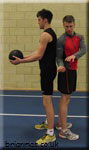
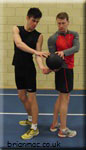
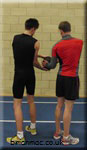
Standing torso twist.
Two sets of ten repetitions (2 x 10) |
||
 |
 |
 |
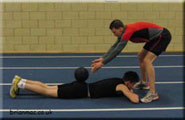
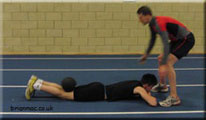
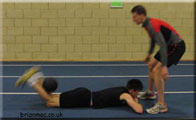
Hamstring curls.
Two sets of eight repetitions (2 x 8) |
||
 |
 |
 |
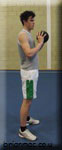
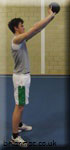
Chest push.
Two sets of eight repetitions (2 x 8) |
||
 |
 |
|
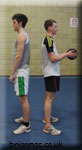
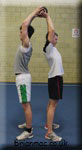
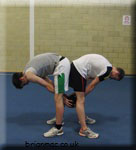
Vertical extensions.
One set of ten repetitions (1 x 10). |
||
 |
 |
 |
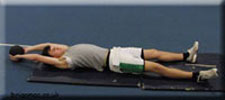
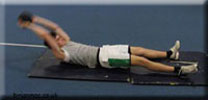
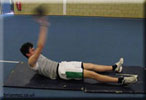
Lay back double-arm throw.
Two sets of eight repetitions (2 x 8). |
||
 |
 |
 |
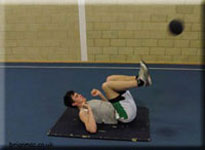
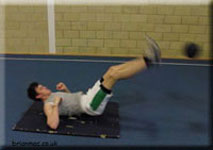
Double leg kicks.
Two sets of ten repetitions (2 x 10) |
||
 |
 |
|
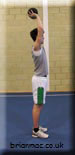
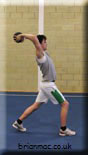
Straight arm standing throw.
Two sets of eight repetitions (2 x 8) |
||
 |
 |
|
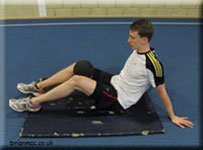
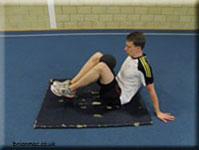
Abdominal curl.
One set of twelve repetitions (1 x 12) |
||
 |
 |
|
How much?
An effective workout with medicine balls can be achieved in about 30 to 40 minutes if the athlete works efficiently. Each session should consist of 8 to 10 exercises, with the athlete performing 2 to 3 sets of each exercise. If the athlete is to improve strength and muscular endurance, conduct 6 to 12 repetitions of each exercise. If the athlete is to develop muscular endurance rather than strength, then perform 12 to 30 repetitions. Carry out two or three weekly sessions with a recovery period of 36 to 48 hours between sessions.
The medicine ball's weight - starts at 3 kg for boys and 2 kg for girls.
References
- JONES, M. (1997) Strength Conditioning with Medicine Balls. Leeds: The National Coaching Foundation.
Page Reference
If you quote information from this page in your work, then the reference for this page is:
- MACKENZIE, B. (1997) Medicine Ball Training [WWW] Available from: https://www.brianmac.co.uk/medball.htm [Accessed