

Calorie-based Astrand Test
If your bike or exercise machine does not have a workload readout in watts but provides a "calorie" reading, then this Calorie-based test is for you.
Test Process
- Use your bike or rower as usual for 2 minutes to warm up, at a Pedal Rate of 60 rpm.
- Adjust the loading until your pulse is at least 130.
- Start the test if you can reset your computer to zero the timer and calorie readouts without affecting your loading.
- If you cannot reset your computer because it controls your machine's loading when you are ready to start the test, make a note of your start time and start calories.
- Exercise for 6 minutes at that load with a constant pedal/stroke rate, and then note your Pulse Rate and end calorie count reading at the 6-minute point.
- Stop exercising or carry on to finish.
- Cool down in your usual manner.
Results Evaluation
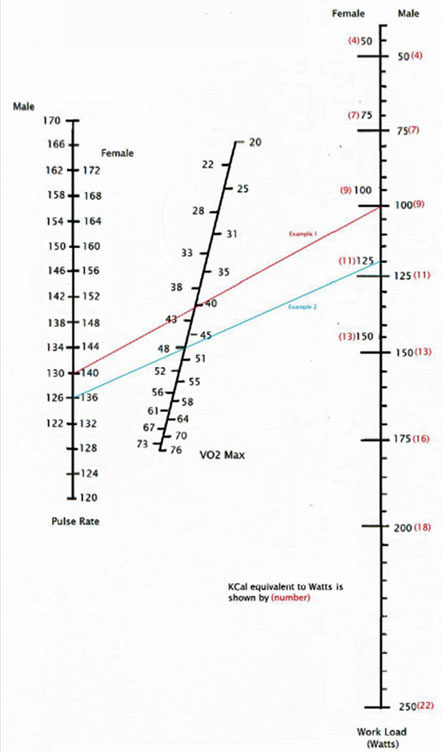
The Nomogram below is used to evaluate your results. It has pulse rate readings, workload, and equivalent calorie count readings (in red numbers) for Males and Females.
Decide which sex you are, then:
- Locate your pulse rate on the left-hand line.
- Work out the calories you have burned. (End number – Start Number)
- Locate your workload on the right-hand line by calorie count.
- See where a line between your two points intersects the middle line – that is your VO2 max index.
An example line, in blue, has been drawn on the Nonogram diagram below for a 35-year-old female with a pulse rate of 136 who consumed 11 Calories in 6 minutes. Her resulting VO2 max index is 48.
A larger PDF copy of the Nonogram diagram below is available at this link - Astrand-Rhyming Nomogram[2]
VO2Max Index Tables
Two tables are provided at the bottom of the Nomogram, one for Females and the other for Males. Choose the row appropriate to your age and see where your index number appears. The column title will tell you your overall level of fitness.
In our example above, our female 35-year-old with a VO2 max of 48 gains a fitness rating of "Superior."
Normative data (Heywood 2006)[1] for Females (values in ml/kg/min)
| Age | Poor | Fair | Good | Excellent | Superior |
| 20 - 29 | <36 | 36 - 39 | 40 - 43 | 44 - 49 | >49 |
| 30 - 39 | <34 | 34 - 36 | 37 - 40 | 41 - 45 | >45 |
| 40 - 49 | <32 | 32 - 34 | 35 - 38 | 39 - 44 | >44 |
| 50 - 59 | <25 | 25 - 28 | 29 - 30 | 31 - 34 | >34 |
| 60 - 69 | <26 | 26 - 28 | 29 - 31 | 32 - 35 | >35 |
| 70 - 79 | <24 | 24 - 26 | 27 - 29 | 30 - 35 | >35 |
Normative data (Heywood 2006)[1] for Males (values in ml/kg/min)
| Age | Poor | Fair | Good | Excellent | Superior |
| 20 - 29 | <42 | 42 - 45 | 46 - 50 | 51 - 55 | >55 |
| 30 - 39 | <41 | 41 - 43 | 44 - 47 | 48 - 53 | >53 |
| 40 - 49 | <38 | 38 - 41 | 42 - 45 | 46 - 52 | >52 |
| 50 - 59 | <35 | 35 - 37 | 38 - 42 | 43 - 49 | >49 |
| 60 - 69 | <31 | 31 - 34 | 35 - 38 | 39 - 45 | >45 |
| 70 - 79 | <28 | 28 - 30 | 31 - 35 | 36 - 41 | >41 |
Why 6 Minutes?
The original Astrand Bike teston which the Nomogram was used was 6 minutes, so I saw no need to change it. The calorie count to workload equivalence (calories to watts) is a derived relationship and depends upon the duration of the exercise session.
There are 360 seconds in a 6-minute session, so if you exercise at 100 watts, that produces 360 x 100 = 36,000 Joules. There are 4.184 Joules in a Calorie. I have rounded this to 4. So, 36,000 Joules divided by 4 = 9,000 calories or 9Kcal. Thus, for a 6-minute session, 100 watts equate to 9 calories.
References
- HEYWOOD, V. (2006). The Physical Fitness Specialist Manual, The Cooper Institute for Aerobics Research, Dallas, TX, revised 2005. In: HEYWOOD, V (2006). Advanced Fitness Assessment and Exercise Prescription, Fifth Edition, Champaign, IL: Human Kinetics.
- ASTRAND, P.O. and RYHMING, I. (1954). A nomogram for the calculation of aerobic capacity (physical fitness) from pulse rate during submaximal work. J Appl Physiol, 7, p. 218-221.
Page Reference
If you quote information from this page in your work, then the reference for this page is:
- DENWOOD, V. (2014). Calorie-based Astrand Test [WWW] Available from: https://www.brianmac.co.uk/articles/article171.htm [Accessed
About the Author
Vic Denwood is a retired RAF Engineer and IBM Business Analyst.