

Long Distance Running
Long-distance covers the 5 kilometres, 10 kilometres, half marathon and marathon events. Comparing past and present world record holders, it would appear that athletes in these events would reach their peak at the following ages:
- 5 km - Male 27 and Female 29.
- 10 km - Male 29 and Female 31.
- Marathon - Male and Female between 31 and 37.
Running Technique
Guidance on the running technique of the long-distance runner is provided in the form of a series of pictures and associated notes that highlight the main technical points.
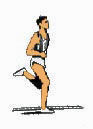 |
The role of the legs is supporting and driving. The foot strikes the ground below the centre of gravity (around the central area of the hips). The strike is slightly on the outside of the heel of the foot and the forward movement is then down the outside of the sole onto the ball of the foot. |
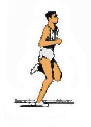 |
As the foot strikes the ground, there is also some flexion in the knee. It should not be excessive, so leg strength must be developed to ensure stability in and around the knee. There is also some movement around the hip girdle. It can be excessive, so strength exercises for the whole region, especially the abdominal and lower back, are required. This region must be kept stable, thus giving a reliable platform to drive. |
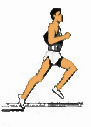 |
As the torso moves ahead of the foot, the drive is initiated and the Achilles and calf are placed under great stress. It is therefore vital that stretching and strengthening of this area are incorporated into training. Muscle fibres in the calf respond to a reflex action as they are stretched and contracted quickly, thus apparently straightening the foot, forcing the athlete up higher on their forefoot. (This makes the foot a further lever, often forgotten by many runners). The foot "grips" the ground as the torso moves ahead, forcing the leg into full extension. Once again, the strength and flexibility of the hamstrings are essential. |
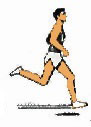 |
After the athlete has reached almost full stretch, a reflex action occurs in the muscle fibres of the hamstring, quickly shortening it and pulling the foot up off the ground. This allows the whole of the limb to swing back a bit further. Hip mobility and the ability to stretch the quads at the front of the leg are also vitally important. |
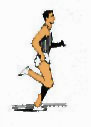 |
The upper part of the leg is drawn forward by the action of the quads, and hip flexors begin to shorten. The foot continues on an upward curve with the help of the contracting hamstring and the hinge effect of the knee joint. It swings into the gluteus maximus (backside), shortening the lever and making it easier to bring forward. |
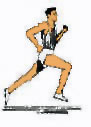 |
The thigh continues forward and then swings upwards. The head of the foot drops from its high point and accelerates downwards and forwards. The knee reaches its high point, which is not relatively as high as that of a sprinter (i.e. at an angle of around 90 degrees to the rear leg). |
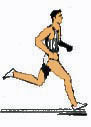 |
The foot ends its swing at a point just ahead of the knee. The leg maintains a slight angle at the knee (the leg is not straight). Having reached its high point, the thigh starts a downward swing; this initiates an acceleration of the foot backwards. |
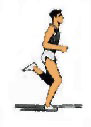 |
The foot strikes the floor in a backward motion, adding to the athlete's forward movement. |
Arm Action
Our speed over the ground is determined by the rate at which our feet strike the ground and the length of our stride - our arm action can effectively control both. The speed at which we move our arms in the direction of travel determines the strike rate, and the range of our arm action determines the stride length. The arm is a lever hinged at the shoulder. Remember, a long leaver is harder to move than a short one. A 90-degree+ bend at the elbow reduces the arm length making it easier to move and control the strike rate.
In all distances of running, the arm action should be active with the hands moving in the direction of travel, focusing on driving the elbows back. The hands should be relaxed, with the thumb uppermost lying gently on top of the index finger. A relaxed hand will help reduce tension and elevation of the shoulders.
Training Programs
A training program has to be developed to meet the athlete's individual needs and consider many factors: gender, age, strengths, weaknesses, objectives, training facilities etc. As all athletes have different needs, a single program suitable for all athletes is not possible.
Training Pathway
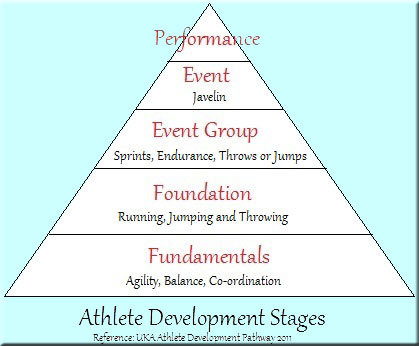
Athletes in the Event Group stage
The following is an annual training program suitable for athletes in the Event Group Development stage:
Athletes in the Event stage
The following are event-specific annual training programs suitable for athletes in the Event development stage:
- 3 kilometres.
- 5 kilometres.
- 10 kilometres.
- Half Marathon - for the experienced endurance athlete.
- Half Marathon - for the novice endurance athlete.
- Marathon - for the experienced endurance athlete.
- Marathon - for the novice endurance athlete - based on mileage.
- Marathon - for the novice endurance athlete - based on time.
Evaluation Tests
The following evaluation tests can be used to monitor the long-distance athlete's development:
- Balke VO2 max test for endurance sports.
- Cooper VO2 max test for endurance sports.
- Quadrathlon is an excellent all-round test.
- Strength test - upper body (Bench Press).
- Strength test - lower body (Leg Press).
- Sit-Ups test - abdominal strength.
- Sit and Reach test - lower back and hamstring test.
- Vertical Jump test.
- vVO2 max and tlimvVO2 max 6-minute test - test to determine distance & time for vVO2 max sessions.
Endurance Time Predictors
Test results make it possible to predict potential times for a long-distance event. The available long-distance time predictors are:
Rules of Competition
The competition rules for this event are available from:
Page Reference
If you quote information from this page in your work, then the reference for this page is:
- MACKENZIE, B. (2001) Long Distance Running [WWW] Available from: https://www.brianmac.co.uk/longdist/index.htm [Accessed