

Long Jump
A long jump is a power event that comprises the following four phases:
- Approach run-up.
- Take-off.
- Flight through the air.
- Landing.
To achieve maximum distance in the long jump the athlete will have to balance three components - speed, technique and strength.
The approach run-up
The objective of the approach run is for the athlete to achieve the ideal speed. Rhythm in the approach run is important to ensure the ideal speed is achieved at take-off and accuracy in hitting the take-off board. The athlete must develop a good running rhythm before accuracy is addressed. The length of the run will depend on the athlete's age and speed. When first determining the number of strides in the approach run start by matching the number of strides with the athlete's age;
| Age | Strides |
| Under 11 | 11 |
| Under 13 | 13 |
| Under 15 | 15 |
| Under 17 | 17 |
| Over 17 | 21 |
The start of the approach run should be marked and the athlete should commence the start from a standing start. Some athletes use a 'walk on start' or 'run on start' that will provide more initial speed but if not consistent will impact the accuracy of the approach run onto the take-off board. The athlete begins the run with a marked forward lean to develop speed but before they reach the take-off board, they should be upright. The athlete should be on the balls of the feet as in sprinting with a natural head position, the eyes focused beyond the pit and not at the take-off board.
The accuracy of the approach run onto the take-off board is established by:
- Determine the take-off foot.
- Stand with your back to the jumping pit and the heel of your non-take-off foot on the take-off board scratch line.
- Run up the runway the required number of strides, say 19 and place a marker where the 19th stride falls.
- Place the non-take-off foot on the marker run back towards the board and take off. The coach should note where the 19th stride lands from the take-off board.
- If the foot is behind the take-off board, say 20cm, then move the start marker 20cm forward. If the foot is beyond the take-off board then move the marker back.
- Repeat the run-up and marker adjustment 4 or 5 times to establish a consistent approach to running onto the take-off board.
- Once achieved measure the distance accurately and record it for future use.
- It is important to bear in mind that a headwind or tailwind will affect the run-up. A headwind may mean moving the marker slightly forward.
Ideal Speed
Dr Graham-Smith and Professor Lees (2002)[3,4] have identified algorithms that will predict an average distance that an athlete would be expected to jump for a given speed. These algorithms are based on official approach speeds and distances collected over ten years from junior and senior championships and Grand Prix events.
- Male - distance = (speed in m/s x 0.95) - 2.23
- Female - distance = (speed in m/s x 0.99) - 2.81
The speed, in metres/second (m/s), can be determined by timing the athlete between two markers set at 11 metres and 1 metre from the take-off board.
The take-off
The preparation for the long jump take-off begins in the later phases of the approach run. The long jumper prepares for take-off by sinking the hips and then raising the hips into the take-off phase. This usually results in the next to last stride being longer than normal and the final stride being up to 25 centimetres shorter than a normal running stride. It must be emphasised that the hip sink and stride adjustment all happen in response to the athlete's postural adjustments in preparation for the take-off. At take-off ensure the hips are slightly forward of the shoulders.
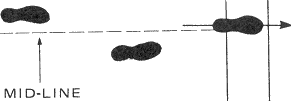
When the take-off foot is placed on the board, it is slightly in advance of the jumper's hips and should strike the board on the mid-line. |
 |
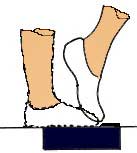
The final two-foot contacts in the take-off should be flat, almost slapping. |
 |
The vertical impulse is achieved by the upward acceleration of the "free" limbs, the arms and the non-take-off leg, against the braced take-off leg. These movements should be characterised by short radius (blocked), and fast explosive actions.
The head should be carried in a normal position, in line with the spine and the eyes should be focused forward and slightly up.
Bilateral Training
Research by Focke et al. (2016)[5] suggests that bilateral practice should be established early in youth long jump training programs to improve the jumping performance of their dominant take-off leg.
A bilateral exercise is one where the stress is placed on both limbs e.g. a bicep curl with a barbell or a squat. A unilateral exercise is one where the stress is placed on one limb e.g. bicep curl with a dumbbell. A bilateral exercise is better for increasing overall muscle strength, but it may impact muscle balance, and unilateral exercise is preferred for developing muscle balance.
The flight through the air
Speed and lift generated on the runway and through take-off can result in a good distance. After take-off, the athlete tends to have a forward rotation that, if not corrected, will result in the feet hitting the sand early and a loss of distance in the jump. The cyclic forward movement of the legs and arms, as seen in the hitch-kick for example, will correct this forward rotation.
The landing
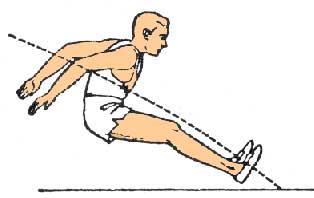
During the landing, the athlete is aiming to get the heels as far away from the take-off board as possible. The ideal landing position is shown in the diagram opposite where the dotted line represents the projected flight path of the body's centre of gravity. The heels will need to land just before the projected flight path to ensure the athlete does not fall back into the sand. As the feet contact the sand, press the heels downwards and contract the hamstrings causing the hips to rise. As the hips rise, twist them to one side and allow the forward momentum to carry the body past the landing position. |
 |
Optimum take-off angle
The take-off speed of a male elite long jumper is about 10.5 metres/second in a "run through" (take-off angle of zero degrees) and 3.5 metres/second for a vertical jump (take-off angle of 90 degrees). This decrease in speed means that the optimum angle of take-off is well below 45 degrees. Linthorne et al. (2005)[1] identify that the optimum take-off angle for a world-class long jumper may be 21.5°± 3.5°. Research by Lees et al. (1994)[2] identifies that the optimum take-off angle for a world-class male long jumper may be 21°± 6°
The stride length of the final two steps before take-off
Based on an adaptation of the table titled "Step lengths of the last three steps before take-off" in John Shepherd's article[6] the approximate length of the 2nd to the last step is the length of the 3rd to final step plus 8.3% and the approximate length of the final step is the length of the 3rd to final step minus 3.04%.
As an example: if the length of the 3rd to final step is 2.26 metres then the length of the 2nd to the last step is 2.26+8.3% = 2.45 metres [((2.26*8.3)/100)+2.26] and the length of the final step is 2.26-3.04% = 2.19 metres. [2.26-((2.26*3.04)/100)]
Long Jump Styles
The Stride Jump
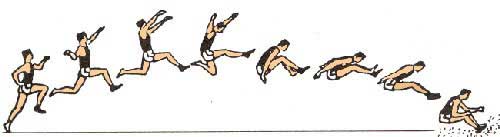
In the "stride jump" style, the athlete maintains the take-off position for as long as possible and only as the athlete comes into land does the take-off leg join the free leg for a good landing position.
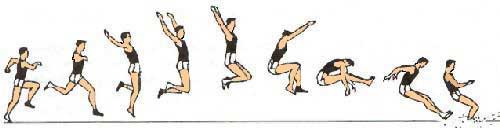
The Hang Style
On take-off, the athlete drops the free leg to the vertical, which is then joined by the take-off leg. The arms go overhead to slow down the rotation of the athlete's centre of gravity. The legs are then lifted upwards and forwards whilst lowering the trunk. The arms swing past the legs during the landing phase to ensure a good leg shoot.
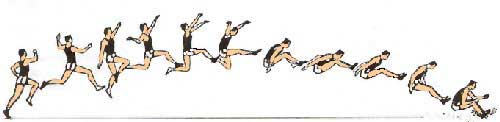
The Hitch-Kick
Following take-off, the free leg is straightened and swung back and down as the take-off leg folds up beneath the hips and comes forward bent. The take-off leg then continues forward, straightening for landing. The free leg completes its backward swing behind the hip and then folds up and moves forwards bent, to join the take-off leg ready for landing.
Training Programs
A training program has to be developed to meet the individual needs of the athlete and take into consideration many factors: gender, age, strengths, weaknesses, objectives, training facilities etc. As all athletes have different needs, a single program suitable for all athletes is not possible.
Training Pathway
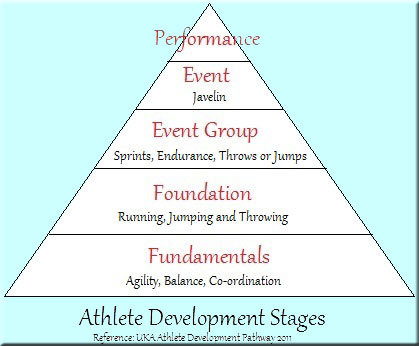
Athletes in the Event Group stage
The following is a basic annual training program suitable for athletes in the Event Group Development stage:
Athletes in the Event stage
The following is an example of a specific annual training program suitable for athletes in the Event development stage:
Evaluation Tests
The following evaluation tests can be used to monitor the long jump athlete's development:
- 10 stride test.
- 60-metre speed test.
- Flying 30 metres speed test.
- Jumps Decathlon.
- Leg Elastic Strength test.
- Standing Long Jump test.
- Strength test - upper body (Bench Press).
- Strength test - lower body (Leg Press).
- Sit-Ups test - abdominal strength.
- Sit and Reach test - lower back and hamstring test.
Rules of Competition
The competition rules for this event are available from:
Free Calculator
- Long Jump Analysis - a free Microsoft Excel spreadsheet that you can download and use on your computer.
References
- LINTHORNE, N.P. et al. (2005) Optimum take-off angle in the long jump. Journal of Sports Sciences, 23(7), p. 703–712.
- LEES, A. et al. (1994) A biomechanical analysis of the last stride, touchdown, and takeoff characteristics of the men's long jump. Journal of Applied Biomechanics, 10 (1), pp. 61-78
- GRAHAM-SMITH, P. and LEES, A. (2002) Finding the balance in the horizontal jumps - part 1 utilising speed. The Coach, May/June(10), p.30-33
- GRAHAM-SMITH, P. and LEES, A. (2002) Finding the balance in the horizontal jumps - part 2 utilising speed. The Coach, July/Aug(11), p.42-45
- FOCKE, A. et al. (2016) Bilateral practice improves dominant leg performance in the long jump. European journal of sports science, 1-7.
- SHEPHERD, J. (2018) Understanding Long Jump Data. Athletics Weekly October 25, 2018, pages 34-36
Page Reference
If you quote information from this page in your work, then the reference for this page is:
- MACKENZIE, B. (2001) Long Jump [WWW] Available from: https://www.brianmac.co.uk/longjump/index.htm [Accessed