
|
|
Core Stability Exercises
Static Floor Exercises
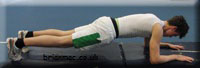
The plank
Hold a straight body position, supported on elbows and
toes. Brace the abdominals and set the low back in the neutral position. Hold
this position for an increasing length of time up to a maximum of one minute.
Perform two to three sets.
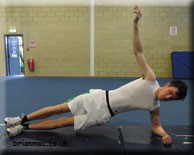
Side Plank
Lie on one side, ensuring the top hip is above the bottom hip.
Push up until there is a straight bodyline through feet, hips and head. Keep
the elbow under the shoulder. Lower under control and repeat on opposite side.
Hold this position for an increasing length of time up to a maximum of one
minute. Perform two to three sets.
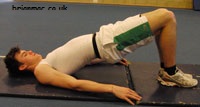
The Gluteal bridge
Lie on the floor with your knees bent. Squeeze your gluteals and
then push your hips up until there is a straight line through knee and hip to
upper body. Shoulders remain on the floor. Beware of rising too high or of
flaring the ribs, which pushes the back into hyperextension. Hold this position
for an increasing length of time up to a maximum of one minute. Perform two to
three sets.
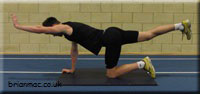
Birddog or Superman
Start with hands below shoulders and knees below hips. Set your low
back into neutral and brace your abdominals slightly. Slowly slide back one leg
and slide forward the opposite arm. Ensure that the back does not slip into
extension, and that the shoulders and pelvis do not tilt sideways. Hold for up
to a maximum of 20 seconds. Slowly bring your leg and arm back and swap sides.
Perform 5 to 10 sets.
Dynamic Floor Exercises
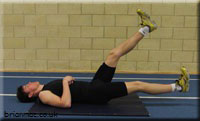
Straight leg raise
Lie on your back with knees bent. Set your lumbar spine in
neutral and brace the abdominals. Lift one leg up straight in the air and
ensure your back does not move. Lift the other leg up keeping your back in
place. Keeping one leg in the air, slowly lower the other down to the floor.
Only go as far as you can until you feel the lumbar spine start to move.
Placing your fingers under your back will help you to gauge when this happens.
Keep bracing the abdominals and then lift the leg slowly back up. Repeat with
the other leg. Perform 2 to 3 sets of 5 to 10 repetitions, alternating legs
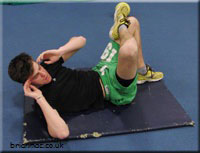
Oblique Crunch
Lie on your back with right ankle resting on left knee. Right arm is
placed on the floor out to the side. Keeping the right shoulder down, curl the
left shoulder up to the right knee. Crunch at the top and return slowly, under
control. Avoid 'head nodding' during the movement: keep head off the floor and
look forward throughout. Perform 2 to 3 sets of 15 to 30 repetitions on each
side in turn.
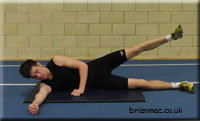
Side lying hip abduction
Lie on your side and set pelvis so your top hip is stacked above
lower hip. Roll shoulders forward a little and brace the abdominals to control
pelvic position. Lift the top leg slowly up and down, without hitching at the
hip. Perform 2 to 3 sets of 20 to 30 repetitions on each side in turn
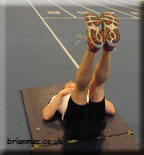
Lying windscreen wipers
Lie on your back with arms out to the sides. Lift legs straight up
in the air until the hip is at 90 degrees. Set the lumbar spine in neutral and
aim to keep it set throughout. Keeping legs straight and maintaining hip angle,
move the legs to one side, controlling any movement in the trunk. Go as far as
you can in control, keeping your upper back and shoulders on the floor. Bring
the legs to a halt, pull them back up to the start position and then over to
the other side, under control. The slow side-to-side movement is like a
'windscreen wiper' arc. Perform 2 to 3 sets of 5 to 10 repetitions
Static Swiss Ball Exercises
 |
Swiss ball
Anti burst gyms balls - 55cm, 65cm and 75cm in diameter. Ideal for a range of core strengthening exercises.
Select this link to order your Swiss ball. |
Sit and leg lift
Sit on a Swiss ball with hips on the top of the ball and feet
hip-width apart. Ensure the size of ball is correct, so that knees are level
with hips and at 90 degrees in sitting. Relax and find a neutral lumbar spine
position. Set this position by lightly bracing your abdominal muscles. Think
about good upper back and shoulder posture as you sit (stomach in, chest
lifted, shoulders low and relaxed). It is important to hold an upright sitting
position - not leaning forward or back. Once you are set, carefully lift one
foot a few centimetres off the floor. Maintain your balance, lumbar and pelvic
alignments as you hold the position on one leg. Hold for a count of 5 to 10.
Perform 5 repetitions each side
Supine Bridge
Lie on your back with heels on the top of the Swiss ball, hip-width
apart to aid stability. Suck in the abdominals and squeeze up from your
gluteals, lifting your hips until there is a straight line from heels to upper
back. Shoulders and head stay firmly on the floor. Take care not to lift the
hips too high or flare the ribs so that your back hyper extends. Hold for 30
seconds and lower. Perform 2 to 3 sets.
Gluteal Bridge
Lie on your back with your shoulders and head on the top of a Swiss
ball; feet on the ground, hip- width apart for stability. Squeezing up from the
gluteals, lift hips until there is a straight line running through the knees,
hips and shoulders. Do not lift the hips too high or flare the ribs so that
your back hyperextends. Hold for 30 seconds and lower. Perform 2 to 3 sets
Plank
Kneel in front of the Swiss ball and place elbows on the top of the
ball in the centre. Slowly roll the ball away from your body until there is a
straight line through knees, hips and head and your weight is being supported
through your elbows down on to the ball. Once in this position it may be
necessary to tilt the pelvis so that it is held in neutral with correct lumbar
spine alignment. Be careful not to round off the shoulders: aim for a 'long
spine'. Hold at the far point for 30 to 60 seconds. Perform 2 to 3 sets.
Back
Kneel over a Swiss ball with thighs and stomach in contact with the
ball and head and shoulders dipping over the front of the ball. With your back
straight and parallel to the floor, position the lumbar spine in neutral and
then set your hips so they do not move. Allow the chest to drop and fall over
the ball, flexing the upper back. Place your hands at the sides of the head,
elbows bent. From this position, lift your chest up, extending your upper back
until it is higher than at the starting position. Maintain abdominal
contraction throughout to fix the hips and limit hyperextension of the lumbar
spine. Perform 2 to 3 sets of 10 to 20 repetitions.
Overhead Pulls
Start in the press-up position with your shins on the ball and
hands shoulder width apart under shoulders. Place knees apart slightly for
stability. Set lumbar spine in neutral and ensure that the shoulders are stable
with shoulder blades down and chest out. Roll backwards until your hands are
above your head, maintaining straight body position and neutral low back. Brace
your abdominals and pull yourself forwards to return to the start position.
Perform 2 to 3 sets of 5 to 10 repetitions.
Squat Thrust
Start in the press-up position with shins on the ball, hands
shoulder-width apart under the shoulders. Place knees slightly apart for
stability. Set lumbar spine in neutral and ensure shoulders are stable with
shoulder blades down and chest out. Pull knees to your chest and crunch the
abdominals to get an extra flex of the hips and back. Slowly extend knees back,
using your abdominals to prevent the hips dropping down. Perform 2 to 3 sets of
10 to 20 repetitions.
Dynamic Swiss Ball Exercises
Side Crunch
Position yourself sideways on the ball, balanced on lower hip with
top hip stacked vertically. Brace feet against a wall, one slightly in front of
the other for stability. Ensure a straight line through legs, hips and
shoulders. Place your hands, elbows bent, by your head. Lift upper body up away
from the ball, crunching sideways towards your feet and focusing upon your
oblique muscles. Slowly return, under control. Perform 2 to 3 sets of 10 to 20
repetitions.
Chop Rotation
Kneel, facing forwards, by the side of the pulley column.
Handle attachment is set at (standing) head height.
Fix the hips square to the front and set your lumbar spine
in neutral. Twisting through the waist, turn shoulders towards the pulley
column and grasp the handle with both hands.
Pull down on the handle, rotating your shoulders away from
the column and crunching down. Finish with hands by your hips and shoulders
facing away. Hips remain square to the front throughout the movement
Perform 2 to 3 sets of 8 to 10 repetitions. |
 |
Lift Rotation
Technique: Kneel, facing forward by the side of the pulley
column. Handle attachment is set just below (kneeling) hip height.
Fix hips square to the front and set your lumbar spine in
neutral. Twisting through the waist, turn shoulders towards the pulley column
and grasp the handle with both hands.
Pull up on the handle, rotating the shoulders away. Finish
with hands above your head and shoulders facing away from the column. Hips
remain square to the front throughout
Perform 2 to 3 sets of 8 to 10 repetitions. |
 |
Pulley Crunch
Technique. Kneel with your back to the pulley column holding a
rope attachment with each hand around your neck. Start with the hips fully
extended (i.e. kneeling fully upright) and pelvis set in neutral. Shoulders,
hips and knees should all be in line and upright.
Focusing on the abdominals, crunch down, pulling the weight and
flexing your trunk forward. The arms simply hold on - avoid using them to
assist in pulling the weight. Ensure the pelvis remains set and stable
throughout: all the movement comes from the spine flexion, so there should be
no hip flexion, forward lean or anterior pelvic tilt
Perform 2 to 3 sets of 5 to 10 repetitions.
Rear Sling
Stand on one leg to the side of the pulley column. Handle is
attached at below-hip height. Grasp the handle with the hand on the opposite
side (opposite to standing as leg). Set perfect posture and pelvic
alignment.
Brace the core and then pull the weight up and around the
body, keeping the elbow straight, so that the arm rotates up and out. Finish
with hand above your head and out to the side slightly.
The aim is to maintain perfect balance and pelvic alignment
as you raise and lower the arm diagonally. Reposition to repeat exercise for
opposite leg/arm.
Perform 2 to 3 sets of 10 to 20 repetitions. |
 |
Front Sling
Stand on one leg to the side of the pulley column. Handle is
attached at above-shoulder height.
Grasp the handle with the arm nearest the column (opposite
side to standing leg). Set perfect posture and pelvic alignment.
Brace your core; pull the weight down and around the body,
keeping the elbow straight so that the arm rotates down and round.
Finish with hand next to your hip across your body.
The aim is to maintain perfect balance and pelvic alignment
as you lower and raise the arm.
Reposition to repeat with opposite leg/arm. Perform 2 to 3
sets of 10 to 20 repetitions. |
 |
One-leg one-arm rowing
Stand on one leg, facing the pulley column. Handle is attached at
waist height. Grasp the handle with the opposite arm (same side as lifted leg).
Your hand will be out directly in front of you in the start position.
Set perfect posture and pelvic alignment, standing tall with
shoulders back. Brace your core; pull on the cable, leading with the elbow in a
rowing movement. Finish with hand by your side and elbow behind you. The aim is
to maintain perfect balance and pelvic alignment as you perform the rowing
movement.
Reposition to repeat with opposite leg/arm. Perform 2 to 3 sets
of 10 repetitions.
Medicine Ball Exercises
 |
Medicine Balls
Medicine balls are a great multi-purpose training tool that can be used alone or with a partner to improve core strength, functional movements, reaction time, and coordination.
Select this link to order your Medicine Balls. |
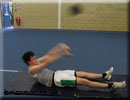
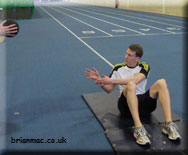
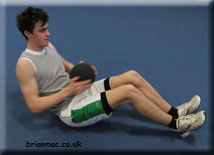
Sit-up and throw
The athlete either needs a partner to receive and pass the ball,
or should perform the exercise in front of a wall and use a medicine ball that
will bounce back.
Start in the sit-up position (knees bent) with hands up ready to
receive the ball. Catch the ball and begin to lower back down. Do not collapse
back down, control it with the abdominals and keep hands above the head as you
lower down.
Once shoulders are touching the floor (keeping head up and eyes
forward), reverse the movement. Throw the ball forward and crunch up at the
same time. Follow the throwing action and complete the sit-up as fast as
possible. Make sure you crunch as you throw so that the abdominals contribute
to the force of the throw and help you sit up faster. Men should start with a
5kg ball; women with a 3kg ball. Perform 2 to 3 sets of 10 to 20
repetitions.
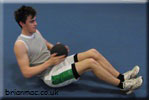
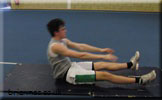
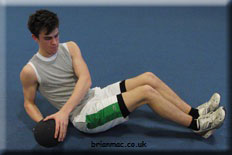
45-degree sit, catch and pass
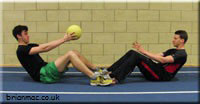
Sit up with knees bent and lean back at 45 degrees, as shown
in the picture right. Aim to hold a 'lengthened' spine, with lumbar spine in
neutral, shoulders' back and neck long and relaxed.
It takes a fair amount of control and strength endurance
simply to hold this posture perfectly. Aim to get this right before progressing
on to the catch and pass.
Raise hands in front of your face and receive a pass from a
partner, around this height. As you catch the ball you must hold the long spine
position.
Do not flex the low back or become round shouldered. Gently
throw the ball back
Men should start with a 3kg ball; women with a 2kg ball.
Complete a few passes, holding the position for 30 seconds. Perform 2 to 3 sets |
 |
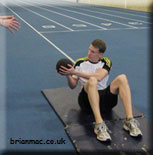
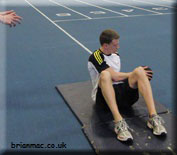
Sit and twist pass
Sit up as shown in the picture above right. Your feet, knees and
hips should remain reasonably still throughout this exercise, the rotation
coming from your waist and not your hips.
Hold hands to one side ready to receive the ball. Catch the ball
to one side and absorb the catch by turning your shoulders further to that
side. Reverse the rotation turning back to the middle and release the ball.
Continue rotating to the other side; receive the ball the other side and
continue.
Ensure you can hold good posture throughout the movement, with a
long spine and wide shoulders.
Men should start with a 4-5kg ball; women with a 2-3kg ball.
Perform 10 to 20 repetitions.
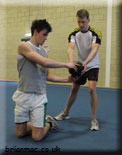
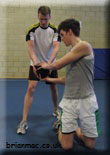
Kneeling twist pass
Kneel upright with good posture (lumbar spine in neutral,
chest out, shoulders low). Start with the ball in your hands, twist the
shoulders and head round as far as you can.
Then, under control, twist around to the other side as far
as possible and hand the ball to partner. Turn back to the start position,
receive the ball again and continue. The aim of the movement is to rotate
through the biggest shoulder turn you have.
You can allow the hips to rotate a little with the
shoulders, but not too much. You should feel a stretch in the side at the end
of each twist.
As you gain greater flexibility and stability, you will be
able to fix your pelvis square to the front and rotate through an increasingly
full range of motion. Men should start with a 5-6kg ball; women with a 3-4kg
ball Perform 10 reps then take the ball to the opposite side and repeat |
 |
One leg twist pass
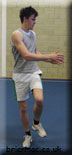
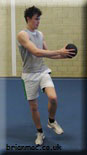
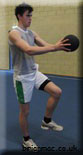
Stand on one leg with hips facing square to the front. Hold
medicine ball in one hand slightly out in front.
Slowly twist from side to side. The rotation comes from the
waist only, head turning with the shoulders.
Keep pelvis fixed square and knee in line with second toe
throughout.
Men should start with a 5-6kg ball; women with a 3-4kg ball.
Perform 2 to 3 sets of 10 slow repetitions. Repeat on other leg |
 |
One-leg deadlifts with rotation
Stand on one leg. Flex the free leg a little at the knee to lift
it off the floor, but do not flex or extend the hip of the free leg throughout
the movement, in order to keep pelvis in control. Hold the ball in front of
you. Bend down, flexing at the knee and the hip.
Lower down until the ball touches the floor by your foot, all the
time keeping your arms straight and without reaching excessively with your
upper back (i.e. maintain a reasonably flat back).
Stand back up, pushing down through the foot to use your gluteals
correctly to extend the hips. Alternate between touching the ball down on the
inside and then the outside of the standing foot. This means you are internally
or externally rotating the hip on alternate repetitions, challenging control of
hip rotation. Keep the knee in line with second toe as much as possible
throughout. Men should use a 5kg ball; women use a 3kg ball. Perform 2 to 3
sets of 5 slow controlled repetitions, build up to 10 repetitions. Repeat on
the opposite leg
One-leg catch and pass
Stand on one leg with good posture (lumbar spine neutral, chest
out and shoulders wide) and with hips square to the front. Hold hands up ready
to catch. Receive catches anywhere within arms' reach. Make sure the passes are
varied in their placement. Aim to move arms and/or turn your shoulders only,
keeping the pelvis and lower limb stable. Use a 2-3kg ball that is not too big,
so it is easy to catch.
Start with 30-second bouts of catch and pass on each leg. Perform
2 to 3 sets
 |
The Stretching Handbook
Here is a simple, effective, and fool-proof way to do away with stiff, aching muscles & joints with just a few easy stretches.
The Stretching Handbook is one of the only books available on the market today to contain photographs (not diagrams, cartoons or illustrations) of over 100 unique, individual stretches. Each stretch targets a specific muscle group, and comes with clear, high quality photographs, as well as a step-by-step description of exactly how the stretch is performed.
Select this link to order your copy of The Stretching Handbook. |
 |
Training for Core Stability
Training for Core Stability brings together the conclusions of recent evidence-based research into the building of core stability for sports-people - how best to build core body strength and stamina, then how to maintain and use it to best effect.
Some of the scientific findings are sure to surprise you - if only because they go against some firmly held training beliefs.
Select this link to order your copy of Training for Core Stability. |
 |
The Stretching DVD
The Stretching DVD contains crucial stretching information like the benefits of flexibility, the rules for safe stretching, and how to stretch properly. Plus, complete visual, step-by-step demonstrations of more than 40 different stretching exercises!
Select this link to order your copy of The Stretching DVD. |
Associated Pages
The following Sports Coach pages should be read in conjunction with this page:
Associated Books
The following books provide more information related to this topic:
- Mobility Training, N. Brook, ISBN 0 85134 079 2
- Strength and Conditioning for Games Players, C. Brewer, ISBN 1 902523 85 7
- Circuit Training for all sports, M. Scholich, ISBN 0 920905 04 8
- Medicine Ball Training, Z. Tenke et al., ISBN 0 92095 40 4
- Strength Conditioning with Medicine Balls, M. Jones, ISBN 0 851 34097 0
- Advanced Studies in Physical Education and Sport, P Beashel et al., ISBN 0 17 4482345
- Physical Education and the Study of Sport, B. Davis et al., ISBN 0 7234 31752
- Essentials of Exercise Physiology, W.D. McArdle et al., ISBN 0 683 30507 7
- Physical Education and Sport Studies, D. Roscoe et al., ISBN 1 901424 20 0
- The World of Sport Examined, P. Beashel et al., ISBN 0 17 438719 9
- Advanced PE for Edexcel, F. Galligan et al., ISBN 0 435 50643 9
- Examining Physical Education, K. Bizley, ISBN 0 435 50660 9
- Sport and PE, K Wesson et al., ISBN 0 340 683821
- PE for you, J. Honeybourne, ISBN 0 7487 3277 2
|
|