

Sit-Ups
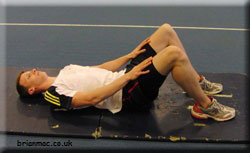
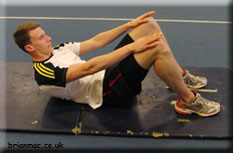
Great care and excellent technique are required to strengthen the abdominal muscles with sit-ups. To be effective, sit-ups must pull the torso upward from a lying position toward the knees using only the abdominal group. However, other, more powerful, muscles (those that flex the legs and hips) do much of the work. This is especially true with straight-leg sit-ups.
Bending the knees during sit-ups helps neutralize the hip flexors' action and makes the abdominal muscles work more. Even so, the abdominal group tends to be involved only in the initial phase of the sit-up, after which the hip flexors take over. Conducting sit-ups with momentum, knees bent or not, does not work for the abdominal group. That is why raising slowly only partway works the abdominal muscles best.
Sit-ups also can be hazardous to your lower back, especially when using the straight-leg variety, which arches the back and may create overextension and strain. Twisting (right elbow to the left knee and vice versa) at the top of the sit-up movement is useless and places tremendous rotational stress on the lower back, which can lead to injury.
Do not interlace the fingers of your hands behind your head, as this will strain the neck - place your hands on either side of the head.
When doing sit-ups, never push through the back pain. Stop immediately at even the slightest twinge in the lower back.
Checklist
|
 |
 |
General conditioning exercises
For general upper body conditioning exercises, including variations of the sit-ups exercise, see the upper body conditioning page.
Page Reference
If you quote information from this page in your work, then the reference for this page is:
- MACKENZIE, B. (1997) Sit Ups [WWW] Available from: https://www.brianmac.co.uk/situps.htm [Accessed