

Upper Body Conditioning
One of the most common sites of injury is the lower back. Injury in this region can be because of muscular imbalance, weak or inflexible muscles or poor posture. The exercises below will help develop the right conditioning level to reduce injury to the lower back.
Detailed below is a session of eight exercises. The exercises are to be performed slowly and smoothly, and at no time should you be out of breath.
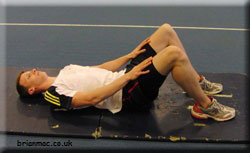
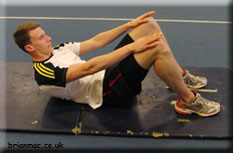
Sit Ups (Upper Abdominals)
- Lie on your back with your legs bent, knees together and feet flat on the floor.
- Rest your hands on your thighs.
- Sit up until the palms of your hands touch your knees.
- Return to the starting position.
- Perform the movements in a slow controlled fashion.
 |
 |
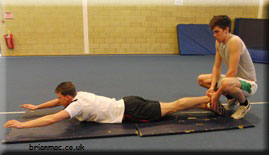
Back Arches (Back)
- Lie on your front with your legs crossed at the ankles, and keep your feet firmly anchored to the floor.
- Hands and arms straight out in front of you.
- Raise your upper body off the floor, and keep your neck in line with your spine.
- Hold for one second and then slowly lower to the floor.
 |
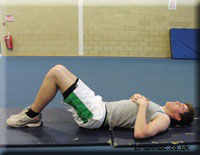
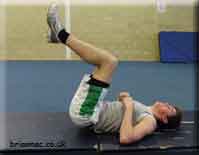
Reverse Curl (Lower Abdominals)
- Lie on your back with your legs bent, knees together and feet flat on the floor.
- Curl up the legs and buttocks off the floor.
- Return to the starting position.
- Perform the movements in a slow controlled fashion.
 |
 |
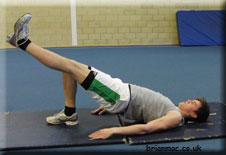
Hip and Leg raise (Gluteals and hamstrings)
- Lie on your back with knees bent, and feet flat on the floor.
- Place your hands by your side.
- Raise hips, straighten one leg and hold for a second before lowering.
- Repeat with the other leg.
 |
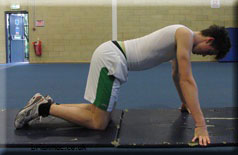
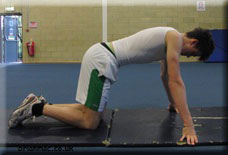
Transversus Abdominis (Abdominal)
- Place yourself in the kneeling position with your hands on the ground.
- Hips directly above the knees.
- Shoulders directly above the hands.
- Keep the spine in a natural position.
- Relax the abdominal muscles and let the tummy sag down.
- Gently pull your tummy button and the area below it towards your spine.
- Hold for 10-15 seconds, and then relax.
 |
 |
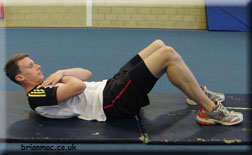
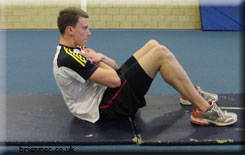
Short sit-ups (Hip flexors and abdominals)
- Lie on your back with knees bent, and feet flat on the floor.
- Rest your hands lightly on your chest.
- Raise your body so that your upper body is at a 30-40-degree angle with the floor.
- Hold for one second before coming down slowly.
 |
 |
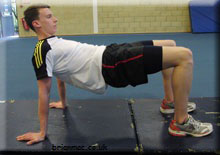
Back Extensions (Back)
- Sit on the floor with legs bent, and feet flat on the floor.
- Position your hands on the floor behind you to take some of the weight.
- Raise your body off the floor so that your body is parallel to the floor.
- Hold for one second and slowly lower.
 |
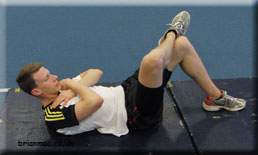
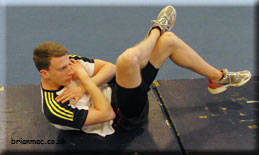
Twisted Curl (Oblique Abdominals)
- Lie on your back with your legs bent, knees together and feet flat on the floor.
- Place the left ankle on the right knee with the left knee pointing away.
- Curl up the right shoulder to the left knee.
- Keep your lower back on the ground.
- Return to the starting position.
- Perform the movements in a slow controlled fashion.
- Repeat with the other leg and shoulder.
 |
 |
How Many and How Often?
Start at one set of ten repetitions. Each week increase the number of repetitions by two. When you reach twenty repetitions, increase the number of sets by one and start again at ten repetitions.
The exercises should be performed two or three times a week and be incorporated into your training schedule.
Before You Start
Before starting any training program, it is recommended that you have a medical examination to ensure it is safe for you to do so.
Page Reference
If you quote information from this page in your work, then the reference for this page is:
- MACKENZIE, B. (1996) Upper Body Conditioning [WWW] Available from: https://www.brianmac.co.uk/conbody.htm [Accessed