

Anaerobic Threshold Testing
The anaerobic threshold (AT) or lactic threshold (LT), the point at which lactic acid starts to accumulate in the muscles, is considered to be somewhere between 85% and 90% of your maximum heart rate (HRmax). The most accurate method of determining your AT is to visit several establishments that can carry out a test under laboratory conditions. This generally costs money and usually means regular blood samples are taken to measure the amount of lactate in the blood during the workout. It is also likely that your VO2 max and HRmax will also be assessed whilst undergoing this test.
As this type of test is not readily available for all of us, the threshold can be discovered in other ways. The methods described below should not be taken as being very accurate in themselves, as not all tests suit everyone, but they can be treated as excellent indicators. A monitor capable of recording your heart rate is essential in all cases.
Threshold Testing
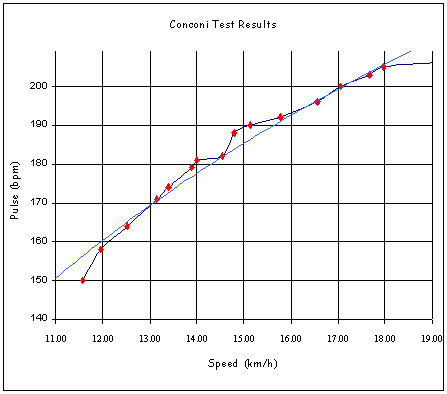
An anaerobic threshold (AT) or lactic threshold heart rate (LTHR) test generally comprises conducting an activity (running, cycling, swimming) for a period of 20 to 30 minutes whilst gradually increasing the effort at set points (distance or time), recording the heart rate at these points, until you are unable to continue with the activity. The recorded heart rates are then plotted on a graph, and you will find the graph gradually rises to start with and then flattens before rising again. This flattening in the graph indicates your anaerobic threshold. In the example graph below for a runner, the anaerobic threshold is approx. 182bpm.
10km run
One method of finding your threshold is to complete a 10km race. Often this distance is run at around the threshold heart rate. You will need to record your heart rate as often as possible and the mile splits. If you are fit, you will run fast and hard and achieve a constant heart rate. For those who are not so fit or start too quickly, the chances are you will, at some point, run above your threshold.
A dramatic drop usually follows this in heart rate and a rise in respiration rate, followed by a drop in pace. Sometimes this is accompanied by a burning sensation in the legs. If you notice these signs while running, check your monitor, as there is a good chance you have discovered your threshold. A 10km race can, of course, be simulated in training. Remember to rest the day before and take it easy for a couple of days after.
Conconi
The Conconi Test (Conconi et al. 1982)[1] can be used to determine your AT although the accuracy of this test is flawed (Jones and Doust, 1995)[2].
% of HRmax
One other method is to take an educated guess based on the assumption that your AT falls between 75 to 85% of your HRmax
AT ≡ ((HRmax - HRrest) x 0.75) + HRrest) ⇒ ((HRmax - HRrest) x 0.85) + HRrest)
The following calculator will do the calculation for you.
Threshold Training
Having discovered your threshold, it is essential to work on improving it. You can start with one or two 6 to 10-minute repetitions, building towards a sustained twenty-minute run. As you become fitter, more 10-minute repetitions can be added to your schedule - say up to six. Your heart rate should be around 5% below your known threshold.
These sessions should be run up to twice a week before peaking for a race season and once a week or less during the endurance build-up - depending on your experience and fitness. These hard threshold runs should be preceded and followed by a recovery run. It is worth recording, charting and analysing all threshold runs. It is advisable to check your threshold every eight to six weeks.
Research by Davis et al. (1979)[3] concluded: "These results demonstrate that the AT is profoundly influenced by endurance training in previously sedentary middle-aged males". Nine sedentary middle-aged males underwent cycle endurance training for 45 minutes/day for nine weeks. At the end of their training, there was a 44% improvement in their anaerobic threshold.
References
- CONCONI, F. et al. (1982) Determination of the anaerobic threshold by a non-invasive field test in runners. Journal of Applied Physiology, 52, p. 869-873
- JONES, A. and DOUST, J. (1995) Lack of reliability in Conconi's heart rate deflection point. International Journal of Sports Medicine, 16, p. 541-544
- DAVIS, J.A. et al. (1979) Anaerobic threshold alterations caused by endurance training in middle-aged men. Journal of Applied Physiology, 46(6), pp.1039-1046.
Page Reference
If you quote information from this page in your work, then the reference for this page is:
- MACKENZIE, B. (1997) Anaerobic Threshold Testing [WWW] Available from: https://www.brianmac.co.uk/hrm3.htm [Accessed