

Conconi Test
Testing and measurement are the means of collecting information upon which subsequent performance evaluations and decisions are made. In the analysis, we need to consider the factors influencing the results.
Objective
The Conconi test (Conconi 1982)[1] is a simple measure of an individual's maximum, anaerobic and aerobic thresholds.
Required Resources
To perform the test, you require
- Heart Rate Monitor (HRmax).
- 400-metre track or Treadmill.
- Stopwatch.
- Assistant.
How to conduct the test
- The athlete determines their starting speed and the increment in speed every 200 metres to complete between 2.5km and 4km before being unable to continue. Using their best 10 km time, the Conconi Test Pace Calculator can determine the time for every 200 metres for the track and the treadmill test's speed.
Conducting the test on a 400m track
- The athlete warms up for 10 minutes.
- The athlete sets the heart rate monitor watch to use a 5-second recording interval.
- The athlete commences the test, starting their HRM watch, and the assistant starts the stopwatch.
- The assistant records the time every 200 metres.
- The athlete increases their speed every 200 metres.
- The assistant stops the stopwatch when the athlete is unable to continue and records the time - the athlete stops their HRM watch recording.
Conducting the Test on a Treadmill
- The athlete warms up for 10 minutes.
- The assistant sets the treadmill speed to the athlete's desired start speed.
- The athlete sets the heart rate monitor watch to use a 5-second recording interval.
- The athlete commences the test, starting their HRM watch, and the assistant starts the stopwatch.
- The assistant records the time every 200 metres.
- The assistant increases the treadmill speed every 200 metres by 0.5km/hr. (0.31mph).
- The assistant stops the stopwatch when the athlete is unable to continue and records the time - the athlete stops their heart rate monitor watch recording.
Assessment
I have been unable to locate any normative data for this test.
Calculation of Anaerobic and Aerobic Threshold
Determine the speed for every 200 metres, then for every 200 metres, plot speed versus heart rate on a graph. The graph gradually rises to start with and then flattens before rising again. This flattening in the graph indicates the athlete's anaerobic threshold. In the example, the Conconi graph below, this flattening appears to be around 182pm. A reasonable estimate for the aerobic threshold has proved to be the anaerobic threshold minus 20 bpm.
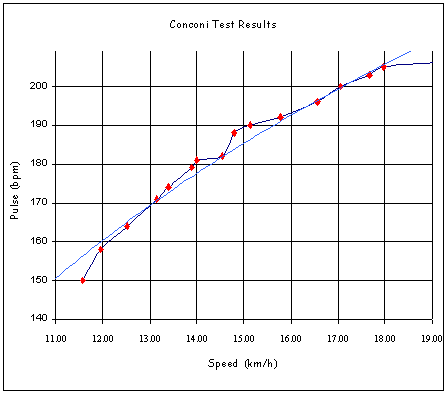
Alternatively, you can use the supplied Conconi AT Calculator to plot and determine the athlete's Anaerobic Threshold.
Analysis
The result is analysed by comparing it with the results of previous tests. It is expected that the analysis would indicate an improvement in the athlete's anaerobic and aerobic thresholds with appropriate training between each test.
Target Group
This test is suitable for endurance athletes and players of endurance sports (e.g. football, rugby) but not for individuals where the test would be contraindicated.
Reliability
Test reliability refers to how a test is consistent and stable in measuring its intended measure. Reliability will depend upon how strictly the test is conducted and the individual's level of motivation to perform the test. The following link provides various factors influencing the results and test reliability. The following link provides various factors influencing the results and test reliability.
Research by Jones (1995)[2] has shown a lack of reliability in Conconi's heart rate deflection point.
Validity
Test validity refers to the degree to which the test measures what it claims to measure and the extent to which inferences, conclusions, and decisions based on test scores are appropriate and meaningful.
Advantages
- Minimal equipment required
- Simple to set up and conduct
Disadvantages
- Specialist equipment required - heart rate monitor/treadmill
- Specific facilities required - 400m track
- Assistant required to administer the test
Free Calculator
The following are free Microsoft Excel spreadsheets that you can download and use on your computer.
References
- CONCONI, F. et al. (1982) Determination of the anaerobic threshold by a non-invasive field test in runners. Journal of Applied Physiology, 52, p. 869-873
- JONES, A. and DOUST, J. (1995) Lack of reliability in Conconi's heart rate deflection point. International Journal of Sports Medicine, 16, p. 541-544
Page Reference
If you quote information from this page in your work, then the reference for this page is:
- MACKENZIE, B. (1997) Conconi Test [WWW] Available from: https://www.brianmac.co.uk/coni.htm [Accessed