|
|
Sprint Starts 
In the sprinting events, there is a need to have an efficient
start. On this page, we look at the standing, crouch and block starts and the
correct positions for the "On your marks" and "Set" positions.
Standing Start
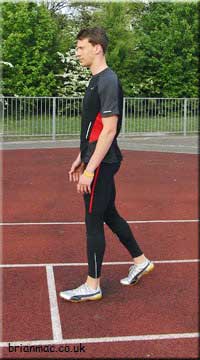 |
On Your
Marks
- The foot is placed up to the starting line but not on
it.
- The feet are about shoulder-width apart to obtain a well-balanced position.
- The weight is distributed so that about 2/3rds of the
weight is on the front foot.
|
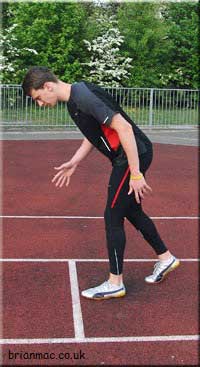 |
- Bend the knees and lean forward.
- Arms synchronised with the legs - in this case, left foot
forward and right arm forward.
- Back, neck and head inline.
- Remain motionless.
|
Crouch 4-point Start
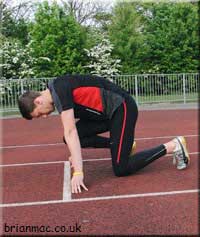 |
On Your
Marks
- Place the left foot behind the line.
- Place the right foot behind the left.
- Remove the left foot and place the left knee adjacent
to the right ankle.
- The toe of the left foot should be turned under.
- Hands should be slightly wider than shoulder-width.
- Arms should be straight but not locked at the elbow.
- The fingers must be behind the line.
- The fingers should form a bridge, with the thumbs
pointing toward one another.
- When viewed from the side, the shoulder should be above
the start line.
- The head and neck should be in line with the spine.
|
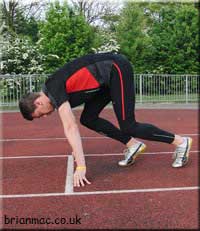 |
Set
- Hips are raised to a position slightly higher than the
shoulders.
- There should be an angle of 90 degrees at the front
knee.
- There should be an angle of 120 degrees on the rear
knee.
- When viewed from the side, the shoulder should be above
the start line.
- The head and neck should be in line with the spine.
- Remain motionless.
|
40 Yard Dash 3-point Start
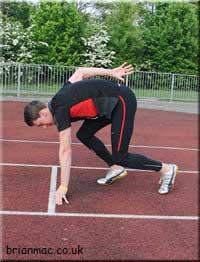 |
- Place your stronger leg, usually the leg you jump off with, in front.
- From a kneeling position, place the left (stronger) foot
forward so that the edges of your toes are approximately 16 to 20 inches behind
the starting line.
- With the knee of your back leg on the ground, position it
alongside the ball of your front foot with a 4 to 6-inch space (fist) between
the legs.
- Extending your right arm out just behind the line, raise
your hips to a position where the angle of the front leg is about 90
degrees, and the angle of the rear leg is about 120 degrees.
- The right hand should be extended up onto the fingertips
with the fingers spread.
- The left arm should rest on the thigh of the left leg or
in a position behind the body as if in a running position.
- Assume a relaxed position with most of your body weight
on the legs and a small amount of your weight on the extended front arm.
- The power at the start comes from your legs, not your
arm, so do not lean too far forward so that too much weight is on your
arm.
|
Block starts
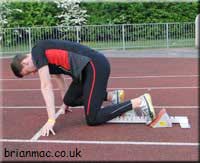 |
On Your
Marks
- Blocks correctly positioned in the lane (200m/400m at a
tangent to the curve).
- Correct distances from the
start line to the front and rear blocks.
- Foot blocks at the correct
angles.
- Blocks firmly located on the track.
- Feet are correctly located in the blocks.
- Fingers behind the line and form a high bridge.
- Hands evenly positioned slightly wider than shoulder-width.
- Shoulders back and vertically above or slightly forward
of the hands.
- Arms straight but not locked at the elbows.
- Head and neck in line with the spine
- Eyes focused on the track (1 to 2 metres ahead).
- Gentle breathing.
- Face and neck muscles relaxed.
|
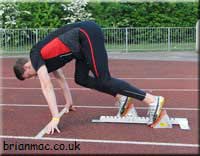 |
Set
- Hold your breath.
- Hips rise slowly to a position above the shoulders.
- Head and neck in line with the spine.
- Eyes focused on the track one or two metres ahead.
- Shoulders vertically above or slightly forward of the
hands.
- Front leg knee angle approx. 90 degrees.
- Rear leg knee angle approx. 120 degrees.
- Feet pushed hard back into the blocks.
|
Types of sprint starts
There are three types of sprint starts:
- Bunch or Bullet start -
- The toes of the rear foot are approximately level with the front foot's heel, and both feet are placed well back from the starting line.
- Medium start - the knee of the rear leg is placed
opposite a point in the front half of the front foot.
- Elongated start - the knee of the rear leg is level with or slightly behind the front foot's heel.
Research by Henry (1952)[2] and Sigerseth & Grinaker (1962)[3] supports the medium start as being the one that offers the most advantage to the sprinter. Compared to the other two starts, the medium start allows the sprinter to exert a higher force against the blocks for the longest possible time, producing the maximum impulse so that the athlete leaves the blocks with the highest possible velocity.
Right foot forward or left?
A question often asked regarding starting blocks is, "Which foot should be in the rear block?" Eikenberry et al. (2008)[1] discovered that when:
- The left foot was in the rear block, reaction time was better.
- The right foot was in the rear block movement and the total response time was better - the time from the stimulus (gun) until the end of the movement.
The results suggest that the right foot in the rear block will produce a more powerful drive from the blocks. Perhaps a way forward would be to evaluate the athlete's times over the first ten metres for both start positions to determine which produces the best acceleration phase for the athlete.
References
- EIKENBERRY, A. et al. (2008) Starting with the "right" foot minimizes sprint start time. Acta Psychol (Amst), 127 (2), p. 495-500
- Henry, F.M. (1952) Force-time characteristics of the sprint start. Research Quarterly, 23, p. 301-318
- SIGERSETH, P.O. and GRINAKER, V.F. (1962) Effect of foot spacing on velocity in sprints. Research Quarterly, 1962
Page Reference
If you quote information from this page in your work, then the reference for this page is:
- MACKENZIE, B. (2001) Sprint Starts [WWW] Available from: https://www.brianmac.co.uk/sprints/starts.htm [Accessed
|
|