

Modified Sit & Reach Test
Testing and measurement are the means of collecting information upon which subsequent performance evaluations and decisions are made. In the analysis, we need to consider the factors influencing the results.
Objective
This test aims to monitor the athlete's hip and trunk flexibility development.
Required Resources
To conduct this test, you will require:
- Box.
- Metre Ruler.
- Tape.
- Assistant.
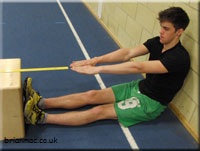
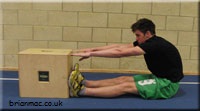
How to conduct the test
|
 |
|
 |
Assessment
The following normative data is available for this test.
The following table is for adults under 35 years of age (McArdle et al. 2000. p. 562)[1]:
| Gender | Excellent | Above average | Average | Below average | Poor |
| Male | >17.9 | 17.9 - 17.0 | 16.9 - 15.8 | 15.7 - 15.0 | <15.0 |
| Female | >17.9 | 17.9 - 16.7 | 16.6 - 16.2 | 16.1 - 15.4 | <15.4 |
The following table is for adults between 35 & 49 years of age (McArdle et al. 2000. p. 562)[1]:
| Gender | Excellent | Above average | Average | Below average | Poor |
| Male | >16.1 | 16.1 - 14.6 | 14.5 - 13.9 | 13.8 - 13.4 | <13.4 |
| Female | >17.4 | 17.4 - 16.2 | 16.1 - 15.2 | 15.1 - 14.5 | <14.5 |
Analysis
Analysis of the test result compares it with the athlete's previous results for this test. It is expected that the study would indicate an improvement in the athlete's flexibility with appropriate training between each test.
Target Group
This test is suitable for active individuals but not for those where the test would be contraindicated.
Reliability
Test reliability refers to how a test is consistent and stable in measuring its intended measure. Reliability will depend upon how strictly the test is conducted and the individual's level of motivation to perform the test. The following link provides a variety of factors influencing the results and test reliability.
Validity
Test validity refers to the degree to which the test measures what it claims to measure and the extent to which inferences, conclusions, and decisions based on test scores are appropriate and meaningful. This test provides a means to monitor training on the athlete's physical development.
Advantages
- Minimal equipment is required.
- Simple to set up and conduct.
- It can be conducted almost anywhere.
Disadvantages
- Specialist equipment is required.
- An assistant is required to administer the test.
References
- McARDLE, W. et al. (2000) Essentials of Exercise Physiology. 2nd ed. Philadelphia: Lippincott, Williams & Wilkins
Page Reference
If you quote information from this page in your work, then the reference for this page is:
- MACKENZIE, B. (2003) Modified Sit and Reach Test [WWW] Available from: https://www.brianmac.co.uk/sitreachmod.htm [Accessed