

Pole Vault Photo Sequence
The following is a Photo sequence of Kory Tarpenning competing in 1992 with comments by Lease (1992)[1].
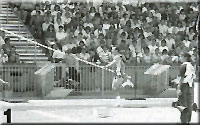 |
Three and a half strides to take off the running technique is good with a complete stride action, high hips and attacking posture. However, the right hand is too low and far behind the vaulter. Consequently, when the transfer or plant has been initiated, this hand will have a long way to travel in a limited time to its eventual high point. |
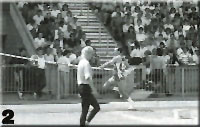 |
While the transfer (plant) may have been
initiated late, it has been initiated from too low a carry position
and is therefore likely to be incomplete entering take-off. Comparable
photographs of Bubka and Tarasov show them carrying the pole at chest height
with the pole horizontal at this phase. An excellent attacking posture is
maintained. |
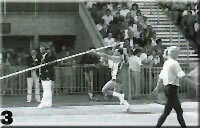 |
The excellent body position is continued when it is challenging to do so. However, the hands are low, and the right shoulder could be further forward. |
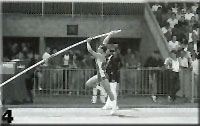 |
Take off. The take-off aims to push the pole to the vertical and hold a suitable position so that later moves can be carried out effectively. The take-off position appears to be excellent despite previous comments. The take-off foot is in an acceptable position directly below the top hand. The jumping action is well demonstrated with the drive up through the chest and left arm. The free knee has been brought through to the correct position. It should be a limited action, unlike the long or high jumper, as the hips and the take-off leg must remain behind the torso for as long as possible. However, photographs can be deceptive, and I suspect some momentum has been lost because of an incomplete arm action into taking off. An improved pole carry and transfer could see Tarpenning using a higher grip on the pole. |
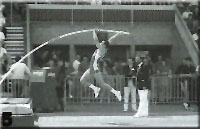 |
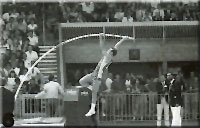
The first point is that the bend is at the top of the pole, indicating that the forces at take-off have been well-directed. The arm action at this stage is still to push the pole vertically. However, the free leg has been allowed to drop, which will likely subtract time for later movements! The left elbow has been turned out to allow the chest to penetrate, but the right shoulder appears to have limited flexibility. |
 |
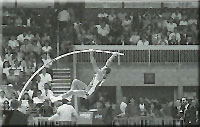
Once again, photographs can give the wrong impression! An excellent hang/swing position is demonstrated, but it is vital to appreciate that the athlete is moving through this position, not holding it! The left arm has been pushed out to stabilise the shoulders, and the arms are now pressing forward. Action/reaction encourages the legs to swing through on the way upside down. |
 |
The arms press forward, and the legs swing up in synchronisation. The free knee is weak and could be driven tighter to the chest. A legacy from dropping it earlier! |
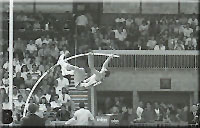 |
Repayment for dropping the free knee earlier is starting to cut deep! Both legs have had to tuck to arrive upside down in time for the anticipated pole recoil. From this point, he must lever upside down rather than swing, and he never quite makes it! A straight leg swing of the take-off leg gives a faster and bigger bend to the pole with a quicker recoil. |
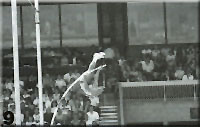 |
Tarperring is well coordinated with good flexibility of the lower back. He is fractionally late but is using these talents to extricate himself well. The hips are low-balanced by the head, which is too far forward. |
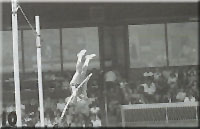 |
The neck should relax to allow the head to roll back into body alignment, and the arms should lengthen. These subtle movements enable the hips to cross the shoulders for total inversion. The head continues to be too far forward, obstructing further progress. |
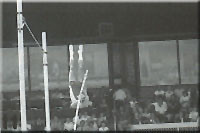 |
Tarperring is still looking at his feet! Hence
total inversion will not be achieved. |
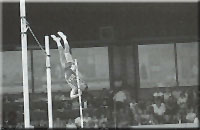 |
The body should be straight and 'tight' like an arrow to receive the pole's recoil. The head is 'back', the athlete looking down to the box, and consequently, his back is arched. |
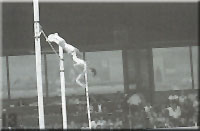 |
A final consequence of the low pole carry! The head-back position is forcing the legs down prematurely. However, he is completely controlled. Dropping the legs early leads to a longer, lower vault which is safer when the bar height is not the critical factor. |
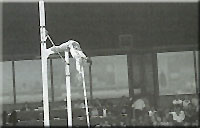 |
The legs must drop as the vaulter loses momentum
on leaving the pole to create a rotation for the bar clearance. The head should
be down for the most effective bar clearance position. |
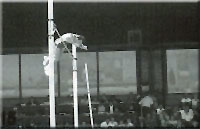 |
He continues to rise after leaving the
pole. His head is down, and his body is arched. The left leg bend is correct and aids
rotation around the bar. This is a practiced technique. Elbows turn out and
concentration is vital at this stage as it dictates whether the vault is
secured or lost. This one was secured! |
Rules of Competition
The competition rules for this event are available from:
References
- LEASE, D. (1994) Kory Tarpenning - Photosequence Analysis. Athletics Coach, 28 (1), p. 16-19
Page Reference
If you quote information from this page in your work, then the reference for this page is:
- MACKENZIE, B. (2004) Pole Vault Photo Sequence [WWW] Available from: https://www.brianmac.co.uk/polevault/photo.htm [Accessed