

Yuhasz Skinfold Test
Measuring body fat percentage makes it easy to discover the correct body weight and composition. Beneath the skin is a layer of subcutaneous fat, and the percentage of total body fat can be measured by taking the 'skinfold' at selected points on the body with a pair of callipers. The Yuhasz Technique uses six sites instead of the three or four sites used in many other tests.
Objective
This test aims to monitor the athlete's level of body fat.
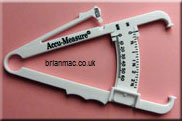
Required ResourcesTo conduct this test, you will require:
|
 |
Measurement Sites
The assistant records measurements taken from the following sites:
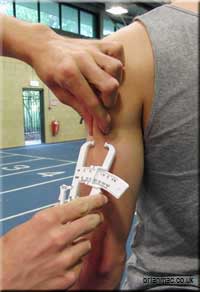 |
Triceps
The assistant takes a vertical fold midway between the shoulder and the elbow on the back of the arm. |
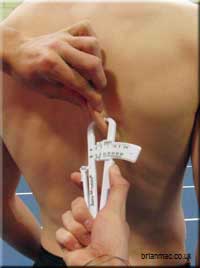 |
Subscapular
The assistant takes a diagonal fold across the back, just below the shoulder blade. |
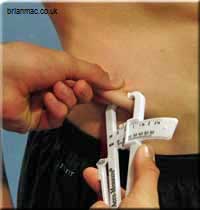 |
Suprailiac
The assistant takes a diagonal fold just above the hip bone. |
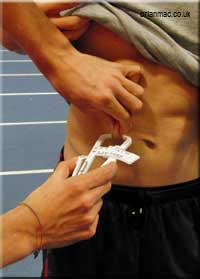 |
Abdomen
The assistant takes a vertical fold midway between the athlete's side and the navel. |
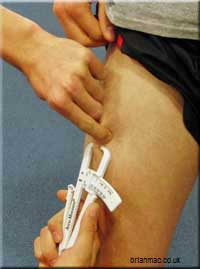 |
Front Thigh
The athlete places their right foot on a six-inch step. The assistant takes a vertical fold midway between the athlete's right hip and knee on the front of the leg. |
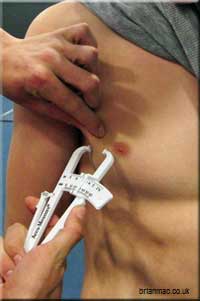 |
Chest (male only)
The assistant takes a fold at a 45-degree angle to the horizontal above and slightly to the right of the athlete's right nipple. |
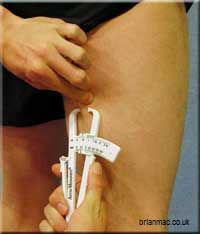 |
Rear thigh (female only)
The athlete places their right foot on a six-inch step. The assistant takes a vertical fold midway between the athlete's hip and knee on the back of the leg. |
How to conduct the test
|
Fat-free Body Mass & Lean Body Mass
Fat-free body mass (FFBM) represents the body mass devoid of all fat, whereas lean body mass (LBM) contains a small percentage of essential fat. LBM is a theoretical value developed by Behnke (1974)[2]. For men Behnke considered it to be FFBM+3% essential fat and for females FFBM+12% fat (3% essential fat + 9% sex-specific essential fat). Many pieces of research use the terms FFBM and LBM interchangeably.
Typical Scores
The average man has 15 to 17% body fat, while the average woman is between 18 and 22%. Typical values for elite athletes are 6% to 12% for men and 12% to 20% for women. The following table details the percentage of body fat for male and female athletes for various sports. Wilmore (1994)[1]
| Sport | Male | Female |
| Baseball | 12-16% | 12-19% |
| Basketball | 6-12% | 20-28% |
| Canoeing | 6-12% | 10-16% |
| Cycling | 5-14% | 15-20% |
| Field Hockey | 8-14% | 12-18% |
| Gymnastics | 5-13% | 10-16% |
| Rowing | 6-14% | 12-19% |
| Swimming | 9-13% | 14-24% |
| Tennis | 12-15% | 16-24% |
| Track - Jumpers | 7-11% | 10-18% |
| Track - Runners | 8-10% | 12-19% |
| Track - Throwers | 14-20% | 20-27% |
| Triathlon | 5-11% | 10-15% |
| Volleyball | 11-14% | 16-24% |
Free Calculator
- Yuhasz Skinfold Test Calculator - a free Microsoft Excel spreadsheet that you can download and use on your computer.
Analysis
Analysis of the test result compares it with the athlete's previous results for this test and recommends body fat levels.
Target Group
This test is suitable for everyone but not for individuals where the test would be contraindicated.
Reliability
Test reliability refers to how a test is consistent and stable in measuring its intended measure. Reliability will depend upon how strictly the test is conducted. The following link provides various factors influencing the results and therefore, the test reliability.
Validity
Test validity refers to the degree to which the test measures what it claims to measure and the extent to which inferences, conclusions, and decisions based on test scores are appropriate and meaningful. This test provides a means to monitor training on the athlete's physical development.
The test is not a good predictor of body fat percentage; however, it can be used to indicate changes in body composition over time.
Advantages
- Minimal equipment is required.
- Simple to set up and conduct.
- Can be conducted almost anywhere.
Disadvantages
- Specialist equipment required - Skinfold callipers.
- An assistant is required to administer the test.
References
- WILMORE, J.H. and COSTILL, D.L. (1994) Physiology of sport and exercise. Champaign, Illinois: Human Kinetics
- BEHNKE, A.R. and WILMORE, J.H. (1974) Evaluation and Regulation of Body Build and Composition. Englewood Cliffs, NJ: Prentice Hall
Page Reference
If you quote information from this page in your work, then the reference for this page is:
- MACKENZIE, B. (2002) Yuhasz Skinfold Test [WWW] Available from: https://www.brianmac.co.uk/fatyuhasz.htm [Accessed