

Dynamic Stretching
The dynamic exercises you incorporate into your warm-up program should be appropriate to the movements you would experience in your sport/event. The following are examples of dynamic stretching and mobility exercises which could form part of the warm-up program in a training session. In all the exercises, breathe easily while performing them.
Research work by McNair (2000)[1] and Knudson (2001)[2] suggests that the use of dynamic stretches - slow controlled movements through the full range of motion - are the most appropriate exercises for the warm-up. By contrast, static stretches are more suitable for the cool-down.
The Exercises
Joint Rotations
From a standing position with your arms hanging loosely at your sides, flex, extend, and rotate each of the following joints:
- Fingers
- Wrist
- Elbows
- Shoulders
- Neck
- Trunk and shoulder blades
- Hips
- Knees
- Ankles
- Feet and toes
Neck Mobility
- Flexion/Extension - Tuck your chin into your chest, and then lift your chin upward as far as possible. 6 to 10 repetitions.
- Lateral Flexion - lower your left ear toward your left shoulder and then your right ear to your right shoulder. 6 to 10 repetitions.
- Rotation - Turn your chin laterally toward your left shoulder and then rotate it toward your right shoulder.
- 6 to 10 repetitions.
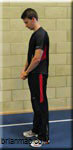 Flexion |
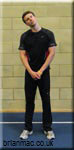 Lateral Flexion |
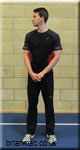 Rotation |
Shoulder Circles
- Stand tall, feet slightly wider than shoulder-width apart, knees slightly bent.
- Raise your right shoulder towards your right ear, and take it backwards, down and then up again in a smooth action.
- 6 to 10 repetitions.
- Repeat with the other shoulder.
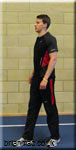 Raise |
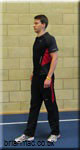 Back |
Down |
Arm Swings
- Stand tall, feet slightly wider than shoulder-width apart, knees slightly bent.
- Keep the back straight at all times.
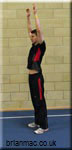
- Overhead/Down and back - Swing both arms continuously to an overhead position and then forward, down, and backward. 6 to 10 repetitions.
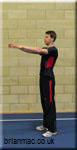
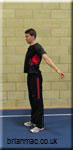
- Side/Front Crossover - Swing both arms out to your sides and then cross them in front of your chest.
- 6 to 10 repetitions.
 |
 |
 |
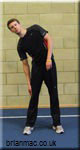
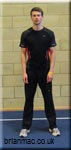
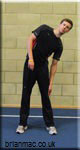
Side Bends
- Stand tall with good posture, feet slightly wider than shoulder-width apart, knees slightly bent, hands resting on hips.
- Lift your trunk up and away from your hips and bend smoothly first to one side, then the other, avoiding the tendency to lean either forward or backward.
- Repeat the whole sequence 6 to 10 times with a slow rhythm, breathing out as you bend to the side and in as you return to the centre.
 |
 |
 |
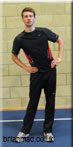
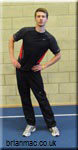
Hip circles and twists
- Circles - With your hands on your hips and feet spread wider than your shoulders, make circles with your hips in a clockwise direction for 6 to 10 repetitions. Then repeat in a counterclockwise direction.
- Twists - Extend your arms to your sides, twist your torso, and hips to the left, shifting your weight to the left foot. Then turn your body to the right while shifting your weight to the right foot.
- 6 to 10 reps on each side.
 |
 |
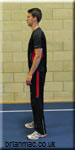
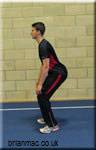
Half Squat
- Stand tall with good posture holding your hands out in front of you for balance.
- Now bend at the knees until your thighs are at 45° with the floor.
- Keep your back long throughout the movement, and look straight ahead.
- Make sure that your knees always point in the same direction as your toes.
- Once at your lowest point, fully straighten your legs to return to your starting position.
- Repeat the exercise sixteen times with a smooth, controlled rhythm.
- Breathe in as you descend and out as you rise.
- 6 to 10 repetitions.
 |
 |
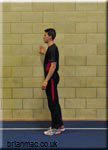
Leg Swings
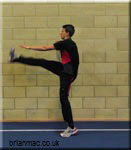
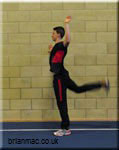
- Flexion/Extension- Stand sideways on to the wall.
- Weight on your left leg and your right hand on the wall for balance.
- Swing your right leg forward and backward.
- 6 to 10 repetitions on each leg.
 |
 |
 |
- Cross-Body flexion/Abduction - Leaning slightly forward with both hands on a wall and your weight on your left leg, swing your right leg to the left in front of your body, pointing your toes upwards as your foot reaches its furthest point of motion.
- Then swing the right leg back to the right as far as comfortable, again pointing your toes up as your foot reaches its final point of movement.
- 6 to 10 repetitions on each leg.
Lunges
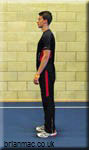
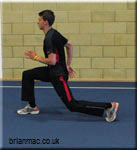
- Standing tall with both feet together (starting position).
- Keeping a straight back lunge forward with the right leg approx. 1 to 1½ metre.
- The right thigh should be parallel with the ground, and the right lower leg vertical.
- Spring back to the starting position.
- Repeat with the left leg.
- 6 to 10 repetitions on each leg.
 |
 |
Ankle Bounce
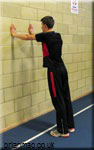
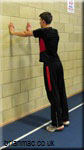
- Double leg bounce - Leaning forward with your hands on the wall and your weight on your toes, raise and lower both heels rapidly (bounce).
- Each time, lift your heels one to two inches from the ground while maintaining ground contact with the ball of your feet.
- 6 to 10 repetitions.
 |
 |
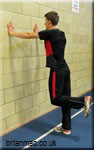
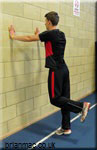
- Single leg bounce - leaning forward with your hands on a wall and all your weight on your left foot, raise the right knee forward while pushing the left heel towards the ground.
- Then lower the right foot to the floor while raising the left heel one or two inches.
- Repeat in a rapid, bouncy fashion.
- 6 to 10 repetitions on each leg.
 |
 |
Certification
If you are a Massage Therapist, Personal Trainer, Strength and Conditioning Coach, Chiropractor, Physical Therapist, Athletics Coach or do any bodywork, then consider certification in Stretching and Flexibility provided by The Stretching Institute.
References
- MCNAIR, P.J. et al. (2000) Stretching at the ankle joint: viscoelastic responses to holds and continuous passive motion. Medicine & Science in Sport and Exercise, 33 (3), p. 354-358
- KNUDSON, D et al. (2001) Acute Effects of Stretching Are Not Evident in the Kinematics of the Vertical Jump, Journal of Strength & Conditioning Research, 15 (1), p. 98-101
Page Reference
If you quote information from this page in your work, then the reference for this page is:
- MACKENZIE, B. (2002) Dynamic Stretching [WWW] Available from: https://www.brianmac.co.uk/dynamic.htm [Accessed