

Dumbbell Exercises
The following are details of various exercises that can be performed using dumbbells.
Exercises
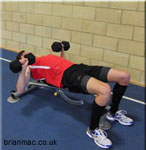
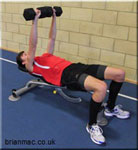
Decline dumbbell bench press
Muscles - Pectoralis Major (lower chest), Anterior Deltoids
- Hold a dumbbell in each hand using an overhand grip while sitting at the high end of a decline bench.
- Rest the dumbbells in an upright position on the knees.
- Lie on the flat bench, simultaneously bringing the dumbbells to a position where they are held at the sides of the torso at chest level.
- Raise the dumbbells to a position of straight arm's length (elbows not locked).
- At this point, the dumbbells are held directly over the chest area, in contact with each other, with palms facing forward.
- Slowly bend the arms and lower the dumbbells until they are on either side of the chest.
- Dumbbells are lowered to a position where a comfortable but maximum stretch is achieved.
- Raise the dumbbells from the sides of the chest to the starting position.
 |
 |
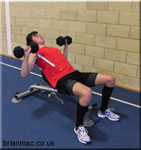
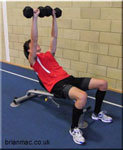
Incline dumbbell bench press
Muscles - Pectoralis Minor (upper chest), Anterior Deltoids
- Hold a dumbbell in each hand using an overhand grip while sitting at the edge of the incline bench.
- Rest the dumbbells in an upright position on the knees.
- Lie on the incline bench, simultaneously bringing the dumbbells to a position where they are held at the sides of the torso at chest level.
- Raise the dumbbells to a position of straight arm's length (elbows not locked).
- At this point, the dumbbells are held directly over the upper chest, in contact with each other, while the palms are facing forward.
- Slowly bend the arms and lower the dumbbells until they are on either side of the chest.
- Dumbbells are lowered to a position where a comfortable stretch is achieved.
- Raise the dumbbells from the sides of the chest to the starting position.
 |
 |
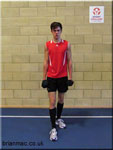
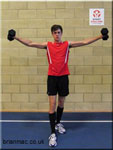
Standing dumbbell side laterals
Muscles - Medial Deltoids
- Stand with back straight, knees slightly bent, and feet slightly less than shoulder-width apart.
- Keep back erect and elbows slightly flexed throughout the entire movement.
- Hold a dumbbell in each hand using an overhand grip, with palms facing each other.
- Press dumbbells together approximately 4 to 6 inches in front of the hips.
- Keeping elbows slightly bent, raise the dumbbells laterally, in an arc toward the ceiling until arms are parallel to the floor, and hold briefly.
- Slowly lower the dumbbells to the starting position.
 |
 |
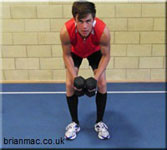
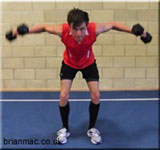
Standing dumbbell bent laterals
Muscles - Posterior Deltoids, Medial Deltoids, Upper Trapezius
- Stand with back straight, knees bent, and feet shoulder-width apart.
- Hold a dumbbell in each hand using an overhand grip, with palms facing each other.
- Bend at the hips until the back is parallel to the floor and the arms are hanging down in an extended position (arms perpendicular to the floor).
- Keeping elbows slightly bent, raise the dumbbells laterally in an arc-like motion until arms are parallel to the floor.
- Slowly lower the dumbbells to the starting position.
 |
 |
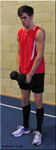
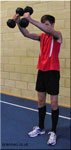
Standing front dumbbell raises (alternate)
Muscles - Anterior deltoids
- Stand with back straight, knees slightly bent, and feet slightly less than shoulder-width apart.
- Hold a dumbbell in each hand using an overhand grip with palms facing downward.
- Let arms hang straight down at the sides, holding the dumbbells approximately 2 to 4 inches from upper thigh level.
- Keeping elbows slightly bent throughout the entire movement, raise the left dumbbell from upper thigh level to eye level, and slowly lower the dumbbell to the starting position.
- Repeat the movement with the right dumbbell.
 |
 |
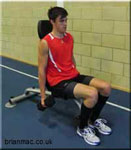
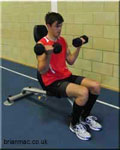
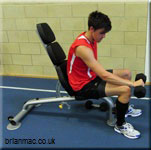
Incline seated dumbbell curls (alternate)
Muscles - Biceps Brachii
- Lie on an incline bench with your back pressed firmly against the padding and feet flat on the floor.
- Hang arms down at the sides, holding a dumbbell in each hand with an underhand grip (palms facing upward).
- Slowly curl the left dumbbell toward your left shoulder.
- When maximum biceps contraction occurs, slowly lower the dumbbell to the starting position.
- Repeat with the right arm.
 |
 |
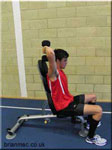
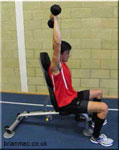
Seated one arm triceps extension
Muscles - Triceps Brachii
- Sit on a flat bench with feet flat on the floor.
- Hold a dumbbell with an overhand grip (palms are facing forward throughout the entire movement).
- Hold the dumbbell overhead with the arm fully extended.
- Lower the dumbbell until the forearm is parallel to the floor.
- At this point, the dumbbell is positioned behind the neck (end position).
- Without bouncing the weight at the bottom of the movement, slowly extend the dumbbell to the starting position and repeat the movement until the desired number of repetitions is completed.
- Repeat for the other hand.
 |
 |
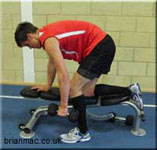
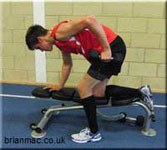
One-arm dumbbell rows (alternate)
Muscles - Latissimus Dorsi, Biceps, Brachialis, Trapezius (mid)
- Hold a dumbbell with the right hand, using an overhand grip (palm facing the body).
- Rest the left knee on a flat bench. The right leg should be flexed with the foot flat on the floor.
- Bend forward at the hips and stabilize the body with a straightened left arm.
- At this point, the torso should be nearly parallel to the floor.
- The dumbbell in the right hand is held at full arm's length.
- Keeping the elbow close to the torso, pull the dumbbell upward in a straight vertical line, allowing it to touch the rib cage lightly.
- Slowly lower the dumbbell to the starting position, and repeat the movement until the desired number of repetitions is completed.
- Repeat for the left hand.
 |
 |
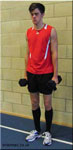
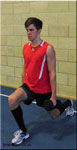
Lunges with dumbbells
Muscles - Quadriceps, Hamstrings, Gluteal muscles
- Hold a dumbbell in each hand with an underhand grip (palms facing the torso).
- Hold the dumbbells at the sides of the body with arms fully extended (palms facing your torso).
- Step forward with the lead leg, keeping the back erect.
- Bend the knee of the lead leg until it has reached a 90-degree angle.
- At this point, the knee of the back leg should be approximately 2 to 3 inches from the floor.
- When fully lowered, push forcefully with the lead leg and return to the starting position.
- Repeat the exercise with your other leg, and continue to alternate until the desired number of repetitions is completed.
- Remember that a shorter lead step allows more emphasis to be placed on the quadriceps muscles and a larger step places more emphasis on the gluteal and hamstring muscles.
 |
 |
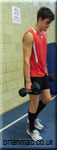
Standing one leg heel raises
Muscles - Soleus & Gastrocnemius
- Hold a dumbbell in each hand with an underhand grip (palms facing the torso).
- Stand with back erect, knees slightly bent.
- Balance on one leg.
- Raise the heel off the ground to balance on the ball of the foot.
- Slowly lower the heel to the ground.
- Repeat the exercise with the other leg.
 |
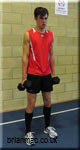
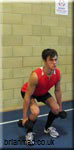
Squats
Muscles - Rectus Femoris
- Hold a dumbbell in each hand with an underhand grip (palms facing the torso).
- Stand with back erect, knees slightly bent, and feet shoulder-width apart.
- Arms fully extend at the side of the body.
- Lower the body until the thighs are parallel to the ground.
- Straighten the legs to return to the start position.
 |
 |
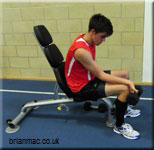
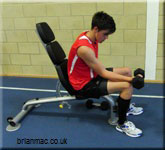
Wrist Curls
Muscles - Forearm flexors
- Hold a dumbbell with an underhand grip (palm facing upward).
- Sit on the end of a bench, feet flat on the floor.
- Allow the forearm to lie on the thigh with the wrist and hand hanging over the end of the knee.
- Allow the dumbbell to be lowered until it is rolled into the fingers.
- Using the forearm muscles, raise the dumbbell by flexing the fingers and curling the wrist.
- Lower the weight to the start position.
- Repeat for the required number of repetitions.
- Repeat with the other hand.
 |
 |
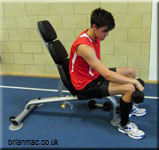
Wrist Extensions
Muscles - Forearm flexors
- Hold a dumbbell with an overhand grip (palm facing downward).
- Sit on the end of a bench, feet flat on the floor.
- Allow the forearm to lie on the thigh with the wrist and hand hanging over the end of the knee.
- Allow the dumbbell to be lowered until it is rolled into the fingers.
- Using the forearm muscles, raise the dumbbell by curling the wrist.
- Lower the weight to the start position.
- Repeat for the required number of repetitions.
- Repeat with the other hand.
 |
 |
Page Reference
If you quote information from this page in your work, then the reference for this page is:
- MACKENZIE, B. (1997) Dumbbell Exercises [WWW] Available from: https://www.brianmac.co.uk/dumexer.htm [Accessed