

The Basketball Triangle Offensive
The following article was provided by Steve Mergelsberg, Assistant Basketball Coach, Rutgers University - Newark, Newark, N.J., U.S.A.
The Triangle Offensive is the brainchild of current Los Angeles Laker assistant coach Tex Winter. The Triangle is based on the execution of the fundamentals and court spacing to produce the best high-percentage scoring opportunities. It is impossible to teach the Triangle or any offence if your players cannot execute offensive skills. At the high school level, players will struggle with the fundamentals of the Triangle such as spacing, crisp passing, changing speeds, cutting and most importantly, reading the defence.
Basic Concepts
While the Triangle offence can be complicated and intricate, the basic concepts can be easily adapted into, lower levels of competition. Once your players accept their roles in this offence, you will be on your way to success. The simpler version of the Triangle offence relies on the same basic concepts as Winter's - proper spacing and movement. Players must be 15 to 18 feet apart so the defence cannot crowd an area and make your players pass ineffective, forcing the offence to break down. In the original Triangle, all offensive movement is in reaction to the defence. High school players will have a difficult time just dealing with the fundamentals needed to run any offence, so do not rely on your players being able to read defences. Instead of being preoccupied with what the defence is doing, have your players focus on running the Triangle and let the opponents attempt to read it.
Basic Triangle Alignment (Right Side)
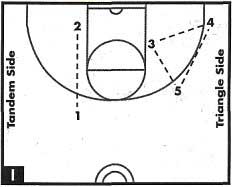 As you can see by the alignment in the diagram [1], this triangle
is on one side of the floor. Opposite the triangle is two players in what is
called the "tandem" side of the offence.
As you can see by the alignment in the diagram [1], this triangle
is on one side of the floor. Opposite the triangle is two players in what is
called the "tandem" side of the offence.
The numbers in the diagram do not represent positions, only players. It would help if you forget the usual assumption that guards play out front, forwards at the wings and centres in the low post.
I tell my players that they are not 1s, 2s, 3s, 4s or 5s but v everyone is a 15! (If you add up all the numbers, it totals 15). Your players must play all these positions when using this offence.
Tandem Entry
Player 1 has the ball. 2 runs to the free-throw line extended from the block area. 1 can pass to 2 and cut for the handoff or keep the ball and use 2 for a pick. If 2 hands the ball off to 1, 2 can roll to the basket for a perfect pick-and-roll. On the triangle side, 3 and 4 will go to the block area and set a double screen for 5. 5 will take his or her assigned defender behind the screen, then pop out toward the tandem side looking for a pass from 2, providing he or she did not handoff to 1. |
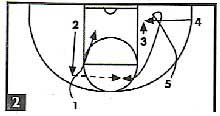 |
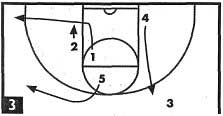
If 5 does not get the ball, he or she continues the route to form the triangle. Without the ball, 1 continues to the corner looking for a pass from 2 and a jump shot. 2 can also pass to 1, slide down the lane and play a two-player game with 1 because that side of the floor is open. 2 can always turn and face-up with the defender for a one-on-one situation. 4 slides up to the tandem post while 3 pops to the top. If 1 has the ball in the corner, 5 ducks into the lane and gets a pass from 1 for an easy layup or dish-off. After the player movements, notice that the triangle and tandem are now on the opposite sides of the floor. For simplicity, try to have every entry with the triangle and tandem on the same side. |
 |
Triangle Entry from Corner
5 has the ball and passes to 4 in the corner to start the series. 3 steps up to set a pick for 5. 5 cuts off 3 looking for a pass from 4. If 5 fails to get a pass from 4, he or she runs a route and curls around 2 looking for a pass from 4. If 5 still does not get a pass, he or she drifts to form the triangle on the left side. As 5 is running through the lane, 3 sets a pick for 4 trying to set up a pick-and-roll. |
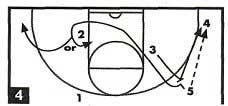 |
If nothing materializes from the corner entry, 4 dribbles to the top as 3 goes to the block area to form the other half of the tandem. Players 5, 2 and 1 make up the triangle on the opposite side. |
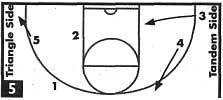 |
Triangle Entry from Post
5 passes to 3 in the post. 4 runs baseline looking for a backdoor pass from 3. As 4 cuts across the baseline, 1 forms a double screen with 2. 4 curls and looks for a pass from 3. If 4 fails to get a pass, he or she proceeds to the top to form the triangle. 2 flares out to the corner and 1 become the triangle-side post 5 can cut off 3 for a handoff or play a two-person game with 3 as soon as 4 clears out. If nothing happens, 3 dribbles out and 5 goes to the post to form the tandem side. 3 also has the option to go one-on-one with the assigned defender. |
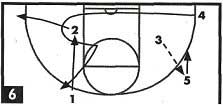 |
Triangle Options
Triangle Post Option5 has the ball, 1 sprints toward 5 for a pass as 3 steps and locks out his or her defender and steps into the lane looking for a quick pass from 1 for a layup. |
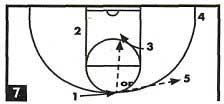 |
Tandem Backdoor Option.2 sprints toward the baseline then jab steps and run to get a pass from 5 at the triangle elbow. 1 takes two or three steps to the left and cuts toward the basket looking for a pass from 5. |
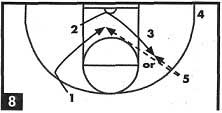 |
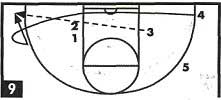
Tandem Screen-And-Shoot Option.Players proceed as in diagram 6. As 4 is just about to curl around the screen, he or she backpedals to the corner looking for a skip pass from 3 for the jump shot. |
 |
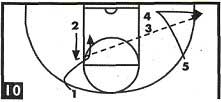
Triangle Pop-And- Shoot Option.Players proceed as in diagram 2 above. 1 passes to 2 and cuts while looking for the return pass. 3 and 4 set a screen for 5. 5 runs the usual route behind the screen, but instead of coming over the screen, he or she pops to the corner looking for a skip pass from 2 for the jump shot. If 5 fails to receive the pass, he or she should come over the screen looking for the pass and shot at the free-throw line area or try to go under the screen for an easy layup. |
 |
Page Reference
If you quote information from this page in your work, then the reference for this page is:
- MERGELSBERG, S. (2005) The Basketball Triangle Offensive [WWW] Available from: https://www.brianmac.co.uk/basketball/trioffen.htm [Accessed