

Drag yourself out of the gym and into shape.
Patrick Dale provides some examples of exercises using a weighted sled.
The weighted sled provides several training opportunities for developing many fitness facets, from low-level cardiovascular conditioning, when performing power walking, to anaerobic conditioning when performing sprints, to muscular endurance, hypertrophy, and strength work. All you need is a level surface (grass, tarmac, or concrete works best) and up to about 60kg of free weights, and you have sufficient resources to perform a sled workout regardless of your outcome goals. |
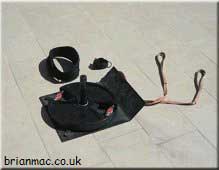 |
Sleds can either be purchased from a strength product retailer or made very cheaply by a local metal worker, being nothing more complicated than a plate of metal with a weight holder in its centre and an upturned front end to prevent catching on debris. Non-elastic straps can be obtained from climbing shops, and as for a waist belt, get your old weight training belt out of the cupboard and use that.
As with all exercise programs, there is no single golden workout that will perform miracles. All workouts will be useful, provided we adhere to our basic training principles of progressive overload, recovery, duration, specificity, and frequency.
With that in mind, this article will provide you with some basic ideas and suggested exercises to get you started. With a weighted sled, dragging your only limit is your imagination, so think “out of the box” and see what ideas you can come up with yourself.
The Exercises
Both of these are great warm-up exercises that are best performed utilizing light loads to prepare us mentally and physically for the work to come.
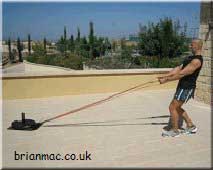
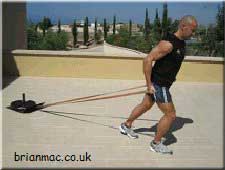
Power Walk.
 |
 |
Power walking backwards using straps. |
Power walking forwards using straps. |
Sideways cross-over walking with straps.
|
A great exercise for those individuals involved in activities requiring lateral movements, e.g., squash, rugby, or football. This can be done either with light resistance and included in your warm-up, or with heavier loads to develop the adductor/abductor muscle complexes. |
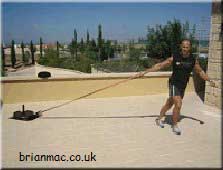
Bent over Walking.
This is an excellent hamstring exercise that is guaranteed to work the posterior chain muscles very effectively. Ensure you maintain a neutral spine. This exercise also lends itself to either low or high resistance, depending on your requirements. Make sure you drive through the heels for maximum effect! |
|
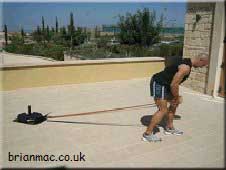
Power walk forward with chest fly.
|
|
Great for muscular endurance and true functional core strength. |
|
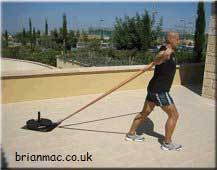
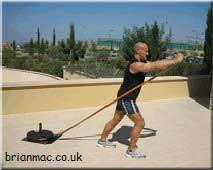
Power walk backward with reverse fly.
|
|
Work those retractors and horizontal extenders while getting a good lower body workout for free! Also requires core stabilization. |
|
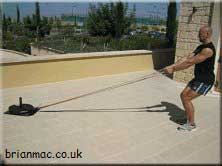
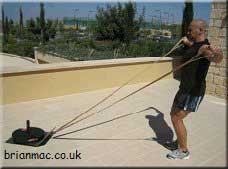
Side steps with cross-body lateral raises/external rotations.
|
|
Working the lateral core musculature, external shoulder rotators, and medial deltoids, as well as hip adductors and abductors, this exercise provides an excellent adjunct to any racket player's exercise routine. |
|
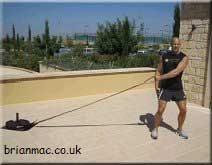
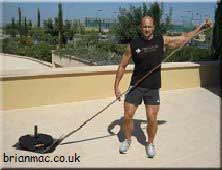
Power walk forward with chest press.
|
|
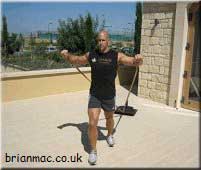
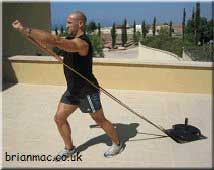
Power walk backward with a row to the chest.
|
|
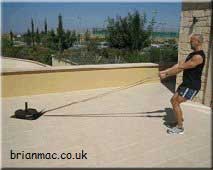
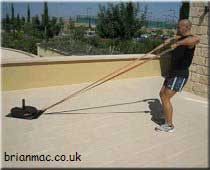
Power walk forward with biceps curl.
|
|
Great arm exercises requiring core stabilization – a functional biceps exercise. |
|
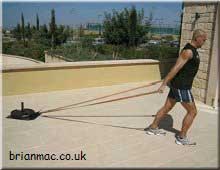
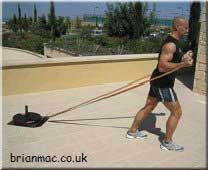
Power walk backward with a row to triceps kickback.
|
|
|
This exercise covers a multitude of muscle groups and is very effective regardless of the load applied. |
||
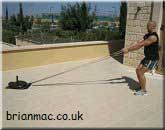
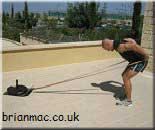
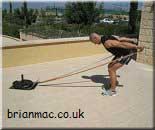
Power walk forward with front raises.
|
|
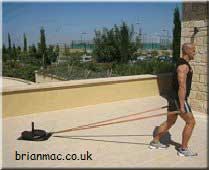
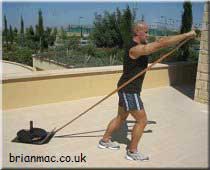
Power walk forward with straps over your shoulders.
|
|
A functional core exercise can be performed with straps over both shoulders to target the rectus abdominis or one shoulder to challenge obliques. |
|
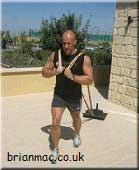
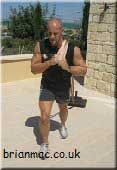
Power walking.
|
|
Power walking forwards with a waist belt. |
Power walking backward with a waist belt. |
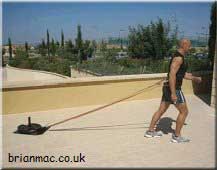
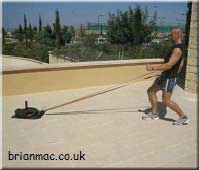
Walking forward offers a unique challenge to the whole of the posterior chain, while walking backward works the quadriceps and hip flexors. The use of the belt permits greater loads to be utilized as core involvement is all but eliminated.
Sprinting with a waist belt
|
A truly excellent way of developing explosive posterior chain musculature, starting power, hypertrophy of the hamstrings, and gluteal or just anaerobic conditioning, depending on the load applied. This can be used before regular sprinting to promote synaptic facilitation. By exposing the body to substantial loading, then removing the load and repeating the movement pattern, the body is fooled into recruiting more muscle fibres than necessary and promoting greater athletic performance. In simple terms, you will run faster when the load is reduced for the second set. |
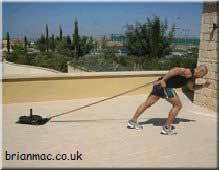
Remember when sprinting to apply the 10% rule if you are concerned with altering technique too much, e.g., only use a 10% greater load in the exercise than an actual activity being trained for. It is fair to use loads that are excessive of this, but the technique, compared to its unloaded variation, will be quite different, and increased strength and power may come at the cost of the altered technique.
Conclusion
Do all of the exercises listed above have one thing in common? They are truly functional. Movement is occurring around numerous joints simultaneously, and harmonious use of body parts is required for each exercise's successful performance. In all strap exercises, the core is called upon to stabilize the mid-section actively. As all activities are done in the standing position, demands on the central nervous system are substantial. Additionally, most of the exercise has no eccentric loading, which reduces the possibility of delayed-onset muscle soreness (DOMS) and permits frequent training sessions. Many powerlifters, Olympic lifters, and field athletes use sled dragging as a recovery tool from heavy gym-based workouts. The light loads used can provide an easy session where waste products can effectively be removed, and nutrient uptake in muscles improves due to the increased blood flow to the working muscles.
Sled training is of particular use to the following groups…
- Sportspeople.
- Those looking to manage their weight.
- Those who dislike the gym environment.
- Anyone looking to improve cardiovascular and muscular fitness simultaneously.
- People with impact-related lower limb injuries who are unable to run (power walking is an excellent alternative to running).
- And anyone wishing to have a break from the regular run-of-the-mill gym-based workouts, and have fun when training!
Whilst the weather in the UK does not always provide a pleasant environment for outdoor training, even in England, the sun sometimes shines, so get outdoors and enjoy it… wrap up warm!
Article Reference
This article first appeared in:
- DALE, P. (2007). Drag yourself out of the gym and into shape. Brian Mackenzie's Successful Coaching, (ISSN 1745-7513/ 43/ June), p. 3-5
Page Reference
If you quote information from this page in your work, then the reference for this page is:
- DALE, P. (2007) Drag yourself out of the gym and into shape [WWW] Available from: https://www.brianmac.co.uk/articles/scni43a2.htm [Accessed
About the Author
Patrick Dale has 15 years of fitness industry experience. He has a wide and varied sporting history, having participated at a high level in athletics, rugby, rock climbing, trampolining, triathlon, weightlifting, and bodybuilding.