

Injury Prevention
Back Injuries in Young Athletes
Dr Larry W. McDaniel, Ed. D., and Christina Cunningham discuss various common back injuries in young athletes.
Introduction
"The most common sources of back pain in adolescence are related to the bony skeleton, the surrounding musculature, and the intervertebral discs. Although consideration must be given to other etiologies, the spinal column is at risk for injury in childhood because of the increased elasticity of stabilizing ligaments" (Macdonald 2007, p. 703)[4]. Examples of extreme movements in the spine are flexion, extension, and rotation. Flexion of the spine is a forward-bending movement. Extension of the spine is moving from the forward bend to a vertical or erect state. Rotation turns the spine to the right or left, while lateral flexion bends to the right or left. Sports require repetitive motion in one direction, putting the spine at risk for developing pathological curves such as scoliosis (Macdonald 2007, p. 704)[4].
Who is at Risk?Back injuries have been reported to be higher in athletes and members of club sports (Uitenbroek 1996, p. 380)[6]. Athletes are at higher risk for back injuries because their physical activities are more frequent and intense. It is common for these participants to injure themselves at least twice in one season. Gymnastics is an example of a sport that constantly uses flexion, extension, and rotational forces in the spine. Reports have demonstrated that the high impact of the bone movement that this sport requires results in back injuries related to acute micro-trauma or repetitive micro-trauma. An example of these injuries is disc generation, which has been strongly associated with gymnastics (see Figure 1). Training over 15 hours per week is a risk factor. |
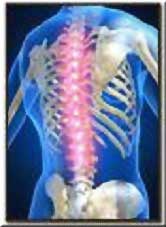 Figure 1 The Spine, 2010 |
Diagnosing Back Pain
Due to the anatomy of the spine, diagnosing back injuries may be complicated. The pain may be localised or radiating. Lumbar pain is a problem in both athletes and the general population. Studies have shown that 80-90% of lumbar injuries are not found. Because the signs and symptoms in this area are difficult to find, they are often misdiagnosed. Although lumbar pain is common, identifying the anatomical source of pain is extremely difficult.
There are three general categories related to adolescents with back pain: muscular, bone-related, and discogenic. These areas classify pain into two broad groups: conditions causing pain with extension and conditions causing pain with flexion. Adolescents may suffer other back injuries: contusions, strains, and sprains. Contusions are a result of a direct blow to the back. It can often lead to hematoma formation, pain, and swelling. Excessive stretching during concentric or eccentric contractions may strain muscles and tendons. A sprain is caused by a ligament stretching beyond its elastic limit. The chances of developing injuries such as strains and sprains or much greater for those who do not warm up or stretch before exercise (MacDonald 2007, p. 708)[4].
"The overall growth of the adolescent can contribute to the development of back pain. Muscle, ligaments, and fascia all lag behind bone growth during early puberty, giving rise to tight back extensors and hip flexors. This tightness can also predispose to overuse injuries." (MacDonald 2007, p. 709)[4].
Common Injuries
A common injury in young athletes is Isthmic spondylolysis. This occurs, as we know, the relationship between the evaluation and rehabilitation of the back is unique. The anatomical cause is not as significant as the symptoms and functions for successful rehabilitation. For that reason, the evaluation of lumbar pain is based on signs and symptoms. Therefore, a general 4-level classification system was developed that does not necessarily identify an anatomical cause. The "red flag" is one level that describes the lumbar pain. Athletes' signs, symptoms, and decreased function are the other three levels. This classification system is used for referral, participation, and rehabilitation decisions. "Given that low back tissues may require the optimal exercise requires judgement based on clinical experience and scientific evidence". (McGill 1998, p. 754)[5]. Specific measuring techniques are the relative importance of strength, flexibility, and endurance.
Understanding the mechanism of injury is important for successfully strengthening the back after an injury. It will help formulate the exercise program and develop injury-avoidance strategies.
Figure 2 shows a technique used during physical therapy to strengthen the back. Rehabilitation exercises are used to challenge muscles and enhance performance, but that is performed in such a way as to minimise the loading of the spine and reduce the risk of injury exacerbation. This is done by putting stress on damaged tissue and healthy supporting tissues to foster tissue repair while avoiding further excessive loading. There are three specific ways of measuring the progression during rehabilitation. Endurance is the leading technique therapists use. Endurance refers to the ability to maintain a force for a while. Another essential technique is strength, which refers to the maximum force a muscle can produce during a single exertion. (McGill 1998, p. 756)[5] |
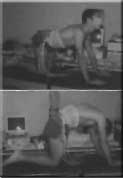 Figure 2 McGill,1998 |
Conclusions
Engaging in exercise and sport has distinct benefits for health and well-being. "Low back pain is a frequent complaint even in the general population of juvenile people, particularly in girls. As many as 30% of adolescents have experienced back pain." (Cupisti 2004, p. 50)[1]. Youth in vigorous competitive sports have a high risk of injury. Football and gymnastics are two sports with a high risk of injury. Because of the repetitive movements and heavy tension on joints, 50-85% of participants are at risk. Adolescents may suffer three types of injuries: contusions, strains, and sprains. Since the back is still developing, muscles, ligaments, and fascia may lag behind bone growth during early puberty, giving rise to tight back extensors and hip flexors. Being at a younger age with greater leanness may prevent some back pain. Those who do not smoke display less anxious/depressive behaviour and increased muscle strength and flexibility. These factors can prevent lower back pain (Cubisti et al. 2004, p. 49)[1].
Understanding the mechanism of injury is essential in developing exercise programs and strategies to avoid injury. "The low back region is an extremely complex mechanical structure, and direct measurement of tissue loading in vivo is not feasible. The only tenable option for tissue load prediction is to utilize sophisticated modelling approaches (McGill, 1998, p. 758)[5]. Recovering from a back injury requires work and patience. It is important to have an appropriate therapy plan to strengthen the injured muscles involved. After the assessment and rehab plan have been implemented, completing the entire program is vital.
References
- CUPISTI, A. et al. (2004) Low back pain in competitive rhythmic gymnastics. Journal of Sports Medicine and Physical Fitness, 44 (1), p. 49
- HECK, F. et al. (2000) A classification system for the assessment of lumbar. Journal of Athletic Training, 35 (2), p. 204
- LEDDY, M. et al. (1994) Psychological consequences of athletics injuries among high level competitors. Research Quarterly for Exercise and Sport, 65 (4), p. 347
- MACDONALD, J.& D'HEMECOURT, P. (2007) Back Pain in the Adolescent Athlete. Pediatric Annals, 36 (11), p. 703-712
- MCGILL, S. (1998) Low back exercises: Evidence for improving exercise regimes. Physical Therapy, 78 (7), p. 754
- UITENBROEK, D.G. (1996) Sports, exercise, and other causes of injuries: Results of a population survey. Research Quarterly for Exercise and Sport, 67 (4), p. 380
Page Reference
If you quote information from this page in your work, then the reference for this page is:
- McDANIEL, L. and CUNNINGHAM, C. (2010) Back Injuries In Young Athletes [WWW] Available from: https://www.brianmac.co.uk/articles/article064.htm [Accessed
About the Authors
Larry W. McDaniel, Ed.D., is an Associate Professor of Exercise Science at Dakota State University, Madison, SD, USA. Dr McDaniel was a First Team All-American football player (USA Football), a Hall of Fame Athlete, and a Hall of Fame Wrestling Coach.
Cristina Cunningham is an outstanding student in Exercise Science at Dakota State University.