

Golf
Exercises to Keep you on the Golf Course
In the game of Life, people are continually looking for something to bring happiness to their day. Happiness is defined differently by every person globabally; some enjoy music, books, movies, sports, etc. Many people love to play sports and play as often and for as long as possible. To do this, these people need to take proactive measures to prevent injury.
The steps to prevent an injury are relatively basic but require good discipline to follow. The athlete needs to start with a healthy diet to have enough energy. Second, the athlete might need to build muscle through exercise to compete depending on the sport. Finally, every athlete should stretch before playing their sport to warm the muscles.
Golf is a physically challenging game. Reading the last sentence might cause you to react with a "what? Golf?". This is an understandable reaction. Most of the professionals have someone that carries their clubs for them, so to the outside observer, it appears as though they are only hitting a ball that does not move and walking.
Regular players have a bit more of a challenge as they have to carry their clubs for the round. Assuming you are not using a cart to drive you around, the regular golfer has to walk roughly 3 miles per 18 holes carrying a 25-30-pound bag on their shoulder and swinging their body regularly. The golf swing itself can be taxing to the human body, as many different parts need to work together to create enough torque for the swing to happen.
Now that I have hopefully convinced you golf can be taxing, you might be wondering what you should do to prepare for playing? The answer, of course, is exercise! You can exercise for strength, flexibility, and what is referred to as "core" are critical exercises necessary for playing the sport. You might think you can get away with not doing any of these, but doing them will give you better odds of playing the sport for a very long time.
So, what exercises should you start with first?
There is not an exact, recommended order for this but strengthening the core of your body (i.e. your abdomen, back, quadriceps, shoulders) is a good starting place. Once your core is strengthened, you can then focus on the other muscles of your body for optimal conditioning.
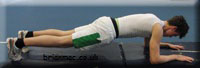
Figure 1 -Plank |
Some of the core exercises might surprise you with their difficulty. One example of this is the plank exercise (see Figure 1). You would think this exercise is easy, but once you have tried it, particularly if you are not in good shape, you will find it is pretty tough. |
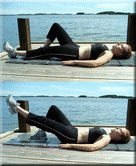
Another good core exercise is the supine leg lift (see figure 2). To perform this exercise, starting from lying flat on the floor, lift one leg in the air and hold it for 1-2 seconds. Do this approximately 10-15 times and then switch legs. Alternatively, you can perform the lateral leg lift exercise (see figure 3); both exercises are good for building up strength in your abdomen and legs.
Figure 2 - Supine leg lift |
Figure 3 - Lateral leg lift |

Everyone wants the "washboard abs" that will look good at the beach. Did you know that the abdominal muscles are vital for your golf swing? The abdominals provide a good deal of the torque necessary for you to drive the ball. One of the best exercises for the abdominals is the crunch (see figure 4). You lie flat on the ground and sit up to bring your shoulders off the ground, using your abdominal muscles to lift you. |
Figure 4 - Crunch |
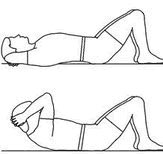
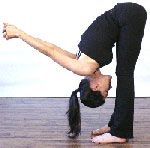
Figure 5 - Bending Stretch |
It is vital to incorporate strength and flexibility exercises into your exercises. Strength exercises such as the bench press can help you develop the power you need to hit the ball further. Flexibility exercises such as the bending stretch (see figure 5) are key to your workout and stretching routine as well. This stretch is central to warming up for a round of golf, as you can see. |
If golf makes you happy as a person, why not prepare your body to enjoy a lifetime of it as long as physically possible? Overuse of muscles or lack of strength can occur easily if you play golf frequently without taking care of your body. Would you prefer to play golf until you are in your 70-80s or have to stop playing in your 40-50s due to poor health? Your 70-80s, of course!
Why warm-up?
The most common reasons given for warming up included:
- To play better (74.5%)
- To prevent injury (27%)
- Because everyone else does (13.2%)
Common reasons for not warming up were:
- Do not need to (38.7%)
- Do not have enough time (36.4%)
- Cannot be bothered (33.7%)
Does it matter, you may ask? Yes, it does for injury prevention since golf is a popular sport with no age limits. The tendency for the players to be older and often not in good physical condition contributes to injury risk. Ironically but perhaps predictably, the more senior golfers in this study were least likely to warm up.
According to emergency departments and sports medicine clinics, the researchers point out that golfers commonly suffer sprains and other overuse injuries, as well as acute traumatic injuries, falls, and impacts with golf balls. Pro-golfers have a higher injury rate (lifetime injury risk of 89% compared with 57-62% for amateurs. Still, beginners tend to have less well-conditioned bodies and place higher stress on their musculoskeletal systems during the golf swing.
An appropriate warm-up for golfers would include aerobic exercise to raise body temperature, followed by stretching the "golf muscles and joints" (hands, wrists, forearms shoulders, lower back, chest, trunk, hamstrings, and groin) and, finally, by a series of golf swings with progressive increases in the range of movement and vigour.
In this study, golfers, who claimed to know what sort of warm-up reduced injury risk, were more likely to warm up than those who did not. And the researchers conclude: "Knowledge of the injury prevention benefits of warming up appears to be a significant motivator of positive attitudes and behaviours".
Page Reference
If you quote information from this page in your work, then the reference for this page is:
- CHERWONIAK, H. (2009) Exercises to Keep you on the Golf Course [WWW] Available from: https://www.brianmac.co.uk/articles/article054.htm [Accessed
About the Author
Herb Cherwoniak has a B.SC in Kinesiology and is an avid golfer.