
Arm Plyometrics
The following is a selection of plyometric exercises designed to develop the elastic strength of the upper body.
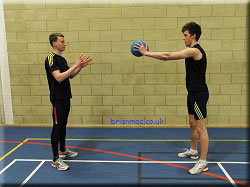
Chest Pass
Resources
This exercise requires an assistant and a medicine ball.
How to perform the exercise
|
 |
How much
- 3 sets of 10 repetitions/set
- 5-minute recovery between each set
- The quality of the passes is far more important than quantity
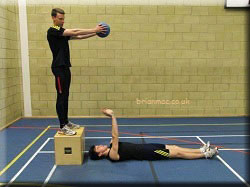
Power Drop
Resources
This exercise requires an assistant, a 40-100cm box and a medicine ball.
How to perform the exercise
|
 |
How much
- 3 sets of 10 repetitions/set
- 5-minute recovery between each set
- Quality of the catch and pass is far more important than quantity
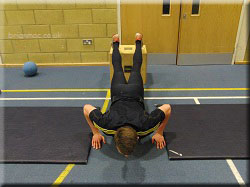
Incline Push up depth jump
Resources
This exercise requires two thick (3") mats and a 12" box
How to perform the exercise
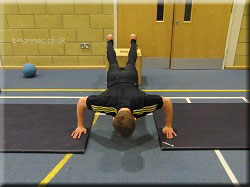
- The two mats are placed shoulder-width apart
- Place the box to elevate the athlete's feet above their shoulders when in a press-up position
- The athlete:
- faces the floor in a press-up position with their feet on the box and their hands between the mats
- pushes off from the ground with their hands and land with one hand on each mat
- pushes off the mats with both hands and back to the starting position
- Keep the hand contact time on the mats as short as possible
 |
 |
How much
- 3 sets of 10 repetitions/set
- 5-minute recovery between each set
- Quality of the push-ups is far more important than quantity
Incline Chest Pass
Resources
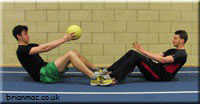
This exercise requires an assistant and a medicine ball
How to perform the exercise
|
 |
How much
- 3 sets of 10 repetitions/set
- 5-minute recovery between each set
- The quality of the passes is far more important than quantity
Vertical Toss
Resources
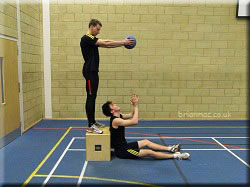
This exercise requires an assistant, a 40-100cm box and a medicine ball
How to perform the exercise
|
 |
How much
- 3 sets of 10 repetitions/set
- 5-minute recovery between each set
- Quality of the passes is far more important than quantity
Catch and throw backhand
Resources
This exercise requires an assistant and a medicine ball
How to perform the exercise
- The athlete stands with their feet shoulder-width apart
- The athlete bends their right arm to 90 degrees and tucks their elbow into their side
- The athlete keeps their trunk facing forward throughout the exercise
- The athlete rotates the right arm out, ready to catch the medicine ball
- The assistant stands to the athlete's right and throws a small medicine ball at the athlete's right hand (Figure 1)
- The athlete catches the medicine ball, takes the medicine ball across the front of the body and throws the medicine ball back to the assistant (Figures 2, 3, 4)
- The athlete should keep their right elbow into their side at all times and focus the effort on their right rear shoulder and external rotator muscles
- The exercise is repeated for the left arm with the assistant standing on the left side
- The athlete should try to anticipate the catch and return the medicine ball as quickly as they can, keeping the catch time as short as possible
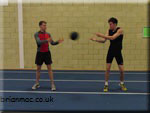 Figure 1 |
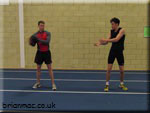 Figure 2 |
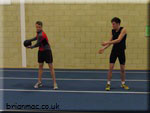 Figure 3 |
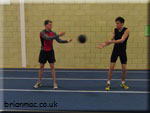 Figure 4 |
How much
- 3 sets of 10 repetitions/set
- 5-minute recovery between each set
- Quality of the throws is far more important than quantity
Warm-Up and Cool Down
A thorough warm-up is essential before plyometric training. Attention should be given to jogging, stretching (dynamic), striding and general mobility, especially to the joints involved in the planned plyometric session. A cool-down should follow each session.
Page Reference
If you quote information from this page in your work, then the reference for this page is:
- MACKENZIE, B. (2000) Arm Plyometrics [WWW] Available from: https://www.brianmac.co.uk/armplyo.htm [Accessed