

Discus Photo sequence
Max Jones comments on the photo sequence of Wolfgang Schmidt in 1991[1].
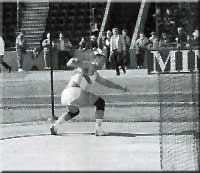 Photo 1 |
Photos 1 & 2 Schmidt exhibits extensive low swings, and it is a mistake to let the body weight become stranded over the right foot (a common fault). Since then, it will be difficult to transfer back to over the left foot 'on entry' and therefore risk entering the turn, off balance. |
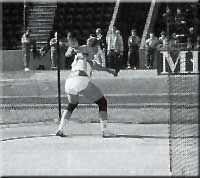 Photo 2 |
|
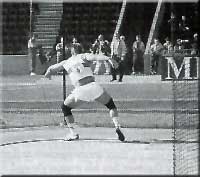 Photo 3 |
Photos 3 & 4 You will observe how balanced Schmidt is during the entry phase. The 'chin over knee over toe' expression is very apt here, with a straight line being drawn vertically from the left toe (Photo 4). The thrower needs to ensure that the left side is not allowed to pull away on entry since this will cause over-rotation and have no linear drive - note how strong Schmidt keeps his left side 'on entry' (Photo 4). The discus is kept high and relaxed, trailing behind the hips (Photo 4). |
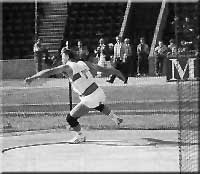 Photo 4 |
|
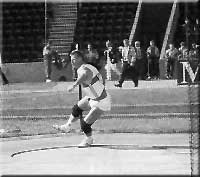 Photo 5 |
Photos 5 to 8 Notice how Schmidt uses a wide sweeping right leg to generate a force that will be directed into the discus during the throw. The left side is kept strong to ensure that a linear drive is maintained and that a balanced throwing position is achieved (Photos 9-10). Care must be taken when using a wide right leg since it is challenging to keep the torso erect on entry when the easy thing to do is to lean back to compensate for the wide right leg. The 'many roads to Rome' saying applies here since using a close right leg has also produced world records. |
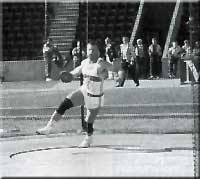 Photo 6 |
|
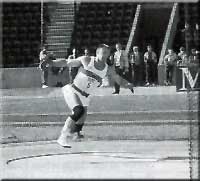 Photo 7 |
|
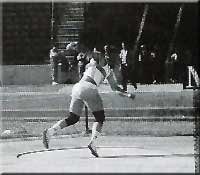 Photo 8 |
|
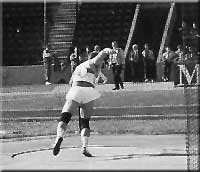 Photo 9 |
Photos 9 & 10 Unfortunately, the left foot grounds somewhere between Photos 9 and 10. Note how Schmidt has arrived in the circle's centre with a more excellent range (Photo 9) - with the discus held high and back and leaning over the right leg. Shoulders faced the rear and were held horizontal with the left arm to the rear (Photo 9). The left foot should land just 'off-centre' to ensure that the hips are allowed to drive through. |
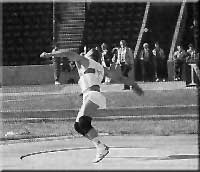 Photo 10 |
|
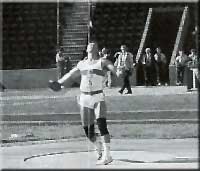 Photo 11 |
Photos 11,12 & 13 The final 'fling' is led by the right hip drive initiated by the right foot. Many throwers allow the right (rear) foot to ground upon landing, which causes a poor late hip strike and makes the throwing arm dominant. Note how Schmidt keeps the discus on a wide radius since letting the discus drop (scooping) will reduce the distance thrown. It is vital to keep the shoulders as level and balanced as possible to avoid 'scooping'. The importance of blocking (Photos 11 & 12) on the left side cannot be overestimated since it maximises the acceleration of the right side and discus. |
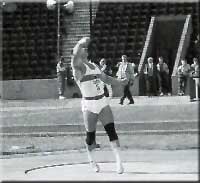 Photo 12 |
|
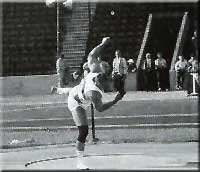 Photo 13 |
Rules of Competition
The competition rules for this event are available from:
References
- JONES, M. (1995) Discus Sequence Analysis. Athletics Coach, 29 (1) p.16-19
Page Reference
If you quote information from this page in your work, then the reference for this page is:
- MACKENZIE, B. (2002) Discus Photo Sequence [WWW] Available from: https://www.brianmac.co.uk/dicus/photo.htm [Accessed