

Injury Prevention
Runner's Foot Injuries
Dr Larry W. McDaniel, Matt Ihler, and Callin Haar discuss typical runners' foot injuries.
There are many sports injuries that runners suffer, and many of these injuries may result from overuse. Other foot problems may be related to chronic injuries that develop over time. This paper will focus on some common injuries suffered to the foot. According to Mike Walden, a former teacher of sports injuries, sports massage, and sports science, "the average runner has between 37-56% risks of injury during a year's training." (Walden 2005)[5]
The specific injuries that will be discussed include typical runner's foot injuries such as Plantar Fasciitis, Metatarsal Stress Fractures, Metatarsalgia, Blisters, Turf toe, and Morton's Neuroma.
Plantar Fasciitis
Plantar Fasciitis is characterized by pain in the inferior heel or the origin of the arch ligament when weight is placed on the foot. The pain is most commonly felt at the attachment of the heel bone. Tenderness and swelling under the heel may be associated with the injury. (Prentice 2006, page 541-543)[4]
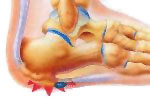 According to Buchbinder (2004)[1], Plantar Fasciitis is not only the most common cause of pain in the inferior heel but is responsible for approximately 10% of all the injuries in connection with running. Also, Plantar Fasciitis accounts for 11 to 15% of all foot symptoms among adults requiring the care of a professional.
This injury is most commonly seen near the origin of the Plantar Fascia at the medial tuberosity of the calcaneous. Plantar Fascia (Plantar Aponeurosis) is a broad flat band of dense connective tissue that runs the entire length of the sole. The non-elastic band of tissue connects proximally to the medial surface of the calcaneous. The primary function of this tissue is to provide support to the foot and protect the longitudinal arch.
Plantar Fasciitis develops due to tension that occurs in the Plantar Fascia during extension of the toes and depression of the longitudinal arch during weight-bearing activities. The development of Plantar Fasciitis is not well understood, yet several factors may play a role in the development of the condition. Some of these factors include obesity, excessive pronation of the foot, heel spurs, prolonged periods of standing, reduced ankle dorsiflexion, and high arches.
The individual usually experiences the most pain in the morning or with increased activity over some time. The pain may subside as the foot warms up but may worsen during the day due to extended periods of walking. Since Plantar Fasciitis is a frequent ailment among runners, it is commonly assumed to result from repetitive microtrauma. (Prentice 2006, page 541-543)[4]
Stress Fractures
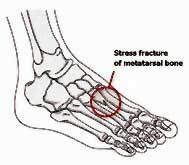 Metatarsal stress fractures are common foot injuries that occur most frequently in running and jumping sports. This type of stress fracture may be classified as an overuse injury. According to Prentice and Arnheim (2005, page 325)[3], this type of injury most commonly occurs because of structural deformities in the foot, changes in training surfaces, training errors, or wearing inappropriate shoes. This type of stress fracture may be classified as an overuse injury.
Additional causes may include a sudden change in training patterns, running hills, running on hard surfaces, or increasing the athlete's mileage.
As stated by Prentice Prentice (2006, page 544)[4], the most common type of metatarsal stress fracture involves an injury to the shaft of the second metatarsal. This particular injury is the March Fracture (such as soldiers marching). Another commonly seen stress fracture affects the fifth metatarsal at the intersection of the Peroneus Brevis Tendon. Athletes that suffer from conditions such as flat foot, structural foot Vargas, Hallux Valgus, or a short first metatarsal may be at an increased risk for this type of injury or fracture. The athlete typically complains of tenderness along the bone in the mid-foot.
Blisters
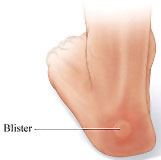 Blisters are common among runners. Blisters are formed by shearing forces or repetitive friction on the skin. Soft skin accompanied by shearing stress to the skin may produce a blister. Fluid accumulates below or within the outer skin layer known as the epidermis when this happens. The fluid may be transparent or bloody, hence the name blood blister. (Prentice 2005, page 331)[3]
A superficial blister contains clear fluid compared to a blood blister in which the deep tissue is disrupted, causing the rupture of blood vessels. Blisters may cause runners a significant amount of pain if not treated properly.
There are many preventative measures an athlete may take regarding blisters. By applying a skin lubricant to the area of the skin where the repetitive friction occurs, wearing correctly fitting shoes, and making sure there are no wrinkles or folds in the socks that are worn may prevent the development of blisters. In case of a friction area or hot spot, an athlete may place a material known as a second skin or a piece of moleskin on the hot spot, reducing the amount of friction in the covered area.
The individual may also apply ice to the hot spots; these methods have proven to be effective in preventing and treating blisters. As a blister forms, the athlete may complain of feeling a hot spot or a sharp burning sensation in the area. The pain accompanied by a blister is due to the accumulation of fluid and pressure it exerts on the nerve endings near the skin. The application of ice may reduce the accumulation of fluid, reduce the size of the hot spot, and relieve pain. (Prentice 2006, page 953)[4]
Metatarsalgia
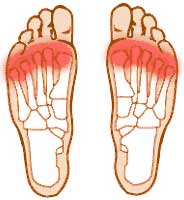 An athlete who suffers from Metatarsalgia complains of having pain at the distal portion of the mid-foot directly over the ball of their foot. (Orthopedic Institute)
Some of the primary causes of Metatarsalgia include the limited extensibility of the Gastrocnemius and Soleus muscles, a fallen metatarsal arch, or cavus deformity. This type of injury results when the healthy skin becomes pinched against the inelastic callus; therefore, the athlete experiences pain when placing weight on the forefoot. (Prentice 2006, page 546)[4]
Pain may occur during palpation and when running or jumping. (Orthopedic Institute) The most common site of this injury is beneath the head of the second and third metatarsals. A heavy callus may form in the area due to the condition. The athlete experiences pain due to the flattening of the transverse arch causing the depression of the heads of the second, third, and fourth metatarsal bones. The symptoms associated with this condition are increased with the mechanism of hyperextension. (Prentice 2006, page 546)[4]
Morton's Neuroma
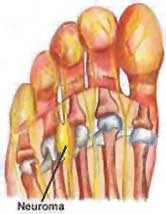 According to Prentice (Prentice 2006, page 546)[4], a Morton's Neuroma usually takes place between the heads of the third and fourth metatarsal. It is the most frequent nerve problem of the lower extremity. This location is where the nerve is the thickest; therefore, it receives branches from the Medial and Lateral Plantar Nerves.
A Neuroma is defined as a mass that occurs with the nerve sheath of the common plantar nerve at the point where it separates into two digital branches of the adjacent toes. The inability of the great toe may characterize the injury to Dorsiflexion. Severe pain starts from the distal metatarsal head, spreads to the tips of the toes, accompanied by burning numbness between or in the toes. (Prentice 2005, page 329)[3]
Also, the collapse of the transverse arch may irritate the injury by stretching the Transverse Metatarsal Ligaments and compressing the common digital nerve and vessels. (Prentice 2006, page 548)[4]
Turf Toe
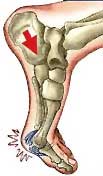 Turf toe is a hyperextension injury resulting in a sprain to the Metatarsophalangeal joint of the Great Toe, commonly known as the "big toe". This type of injury may result from repetitive overuse or by an individual trauma to the foot. (Prentice 2006, page 548)[4]
The most common mechanism that causes Turf Toe is the application of a downward force. Turf Toe accounts for more than 80% of toe injuries. These injuries cause the Great Toe to become Dorsiflexed beyond its biomechanical limits; therefore, resulting in a tear of the capsule. An athlete with Turf Toe may experience a significant amount of pain and swelling around the injured joint. (Prentice 2006, page 548)[4]
As stated by the staff at the Orthopedic Institute, the pain occurs at the Metatarsophalangeal joint where the big toe attaches to the foot. The amount of pain increases when the athlete pushes off their foot. Pain may occur when the foot is moved in extension or while running or jumping. (Orthopedic Institute)
Rehabilitation of Common Runners Foot Injuries
References
- BUCHBINDER, R. (2004) Plantar Fasciitis. The New England Journal of Medicine, 350 (21), p. 2159-2167.
- Care and Prevention of Athletic Injuries (2006) Lecture presented at Sports Medicine for Coaches Workshop 17th Nov, Orthopedic Institute Sports Medicine Center, Sioux Falls, SD.
- PRENTICE, W. and ARNHEIM, D. (2005) Essentials of Athletic Injury Management (6th ed.). New York, NY: McGraw-Hill.
- PRENTICE, W. (2006) Arnheim's Principles of Athletic Training: A Competency-Based Approach, 12th ed.. New York, NY: McGraw-Hill.
- WALDEN, M. (2005) Running Injuries. Update, 71, p. 24-27
Page Reference
If you quote information from this page in your work, then the reference for this page is:
- McDANIEL, L. et al. (2009) Runner's Foot Injuries [WWW] Available from: https://www.brianmac.co.uk/articles/article047.htm [Accessed
About the Authors
Dr Larry McDaniel is an associate professor and advisor for the Exercise Science program at Dakota State University, Madison, SD USA. He is a former All-American in football and Hall of Fame athlete & coach.
Matt Ihler and Callin Haar are students enrolled in Exercise Science at Dakota State University. Both are interested in careers related to Sports Medicine.